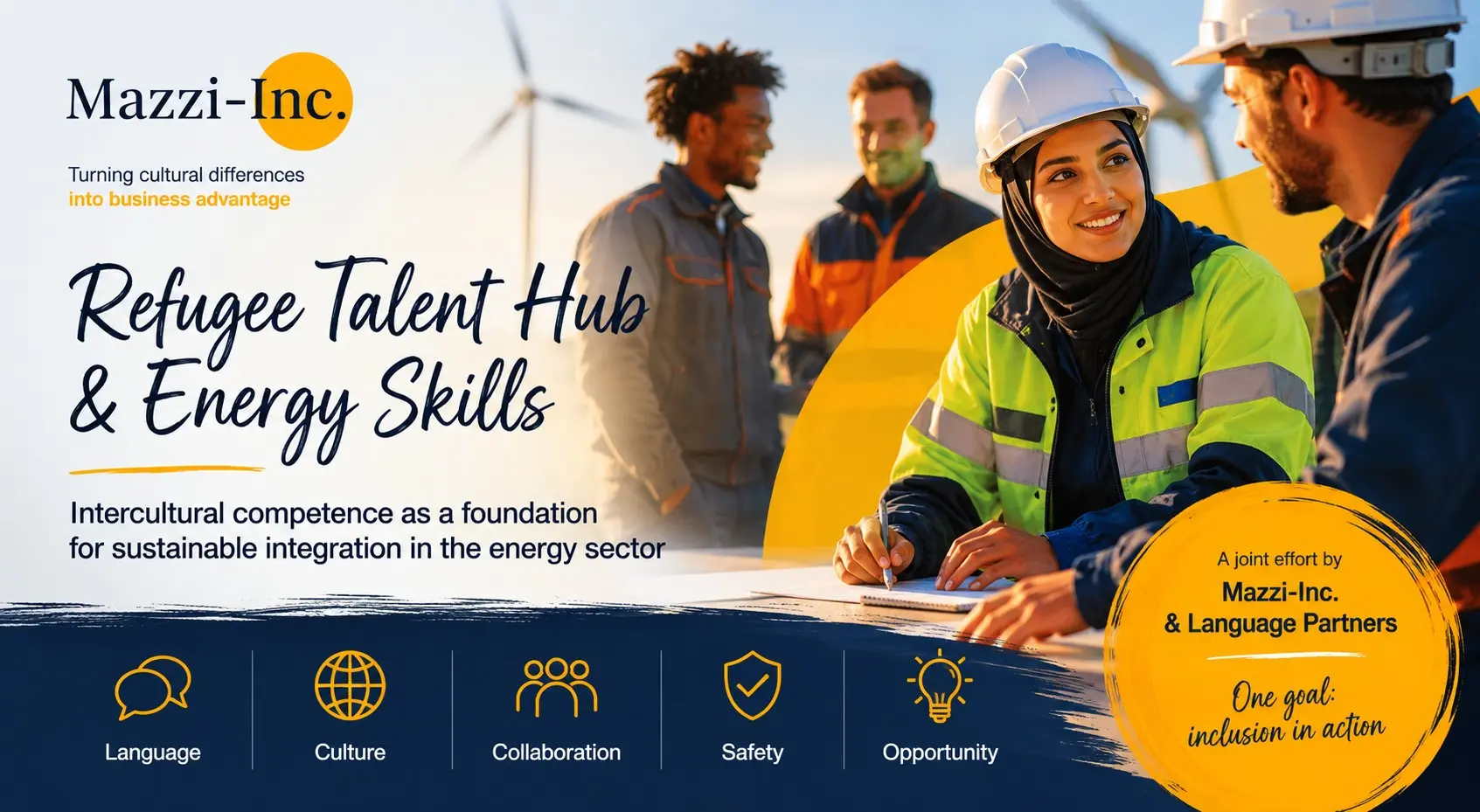
The energy transition is creating a growing demand for skilled professionals. At the same time, many refugees and status holders are eager to build a future and meaningful career in the Netherlands. The Energy Skills Program by Refugee Talent Hub brought these two societal challenges together in one practical and future-oriented initiative.
Within the program, Refugee Talent Hub, Alliander, Enexis, and TenneT collaborated to prepare participants for careers in the energy sector. Over the course of sixteen weeks, participants received technical training, safety education, Dutch language training focused on professional terminology, and guidance in understanding Dutch workplace culture.
To deliver the program, Language Partners and Mazzi-Inc. combined their expertise. Language Partners provided the language training, while Mazzi-Inc. was responsible for the intercultural competence training focused on collaboration, communication, and navigating the Dutch workplace culture.
The challenge
In technical sectors such as energy, safety depends on far more than procedures and technical knowledge alone. Effective collaboration, clear communication, and the confidence to ask questions are equally essential. This is exactly where cultural differences can play a significant role. For participants, working in the Netherlands often meant adapting to new communication styles, workplace expectations, and approaches to hierarchy and collaboration. At the same time, organisations also needed greater awareness of how cultural norms and expectations influence behavior in the workplace. From the start, the Energy Skills Program recognised that successful integration requires more than technical skills or language proficiency alone. Intercultural competence therefore became an intentional and integrated part of the program.
Mazzi-Inc.’s approach
Within the program, Mazzi-Inc. developed and delivered the training How to Work with the Dutch: a practical intercultural competence training specifically designed for status holders preparing to work in the Dutch energy sector.
The training focused on topics such as:
- Dutch workplace culture and communication styles;
- cultural differences in collaboration;
- expectations around feedback and initiative;
- hierarchy versus equality;
- physical and psychological safety at work;
- and understanding implicit norms within Dutch teams.
Participants learned not only how culture influences behavior, but also how to position themselves effectively within Dutch organisations. The sessions included practical examples and recognisable workplace situations from the energy sector, making the training immediately applicable in daily practice.
The training was fully adapted to the participants’ language level, background, and learning needs. Depending on the group, additional visual support, interactive exercises, and practical examples were incorporated into the sessions.
Collaboration with Language Partners
Within Energy Skills, Mazzi-Inc. and Language Partners worked closely together to connect language, culture, and safety into one integrated learning experience. Language Partners delivered the Dutch language training focused on workplace communication, safety instructions, and technical terminology. Language was approached not as a separate skill, but as an essential part of working safely and effectively together. The combination of language development and intercultural competence proved especially powerful. While language training helped participants understand instructions and actively participate in conversations, the intercultural training helped them interpret behavior, expectations, and workplace dynamics more effectively. This created greater trust, stronger collaboration, and a safer working environment.
Results and impact
The program helped participants develop not only technical skills, but also confidence and a stronger sense of belonging within Dutch teams and organisations.
Within the intercultural training sessions, participants actively worked on:
- understanding cultural differences;
- discussing expectations openly;
- collaborating in diverse teams;
- and contributing to a psychologically safe learning environment.
Participants learned how to ask questions, interpret feedback, and communicate more effectively with colleagues and supervisors. This directly contributed to both social and physical safety in the workplace.
At the same time, the program helped organisations make inclusion more tangible in daily practice — not by eliminating differences, but by understanding and discussing them more openly.
A sustainable vision of inclusion
Energy Skills demonstrates that sustainable integration requires more than technical education alone. When organisations invest in language, culture, and collaboration simultaneously, people are better able to become genuine members of a team and organisation. Especially in sectors where teamwork and safety are critical, that makes a substantial difference.
For Mazzi-Inc., this collaboration once again confirmed the importance of intercultural competence within international and diverse work environments — not as an additional layer, but as a fundamental condition for successful collaboration.
Care to learn more about our Intercultural Skills Training Programmes?