Many organisations invest heavily in culture change. New core values are introduced, teams attend workshops, and employees are encouraged to “collaborate differently.” Yet one question often remains unanswered: how do you ensure that new insights actually become part of everyday behavior?
That question also played a central role within a part of the Dutch Tax Authority. The organisation was in the middle of a broader cultural and organisational development process in which intercultural collaboration, communication, and connection between teams were becoming increasingly important. Employees and leadership alike expressed a strong need for greater clarity, stronger alignment, and a work environment where people felt safe to speak up, ask questions, and discuss differences openly.
At the same time, many of the collaboration challenges turned out not to be technical or content-related at all. Instead, they emerged in the interaction between people themselves. Different perspectives, implicit assumptions, communication preferences, and unspoken expectations shaped the way teams worked together on a daily basis.
The request to Mazzi-Inc. therefore went far beyond delivering a traditional communication training. The organisation was looking for an approach that would not only increase awareness of behavior and communication, but would also make visible how these dynamics directly influence collaboration, decision-making, and organisational culture.
A different approach to culture change
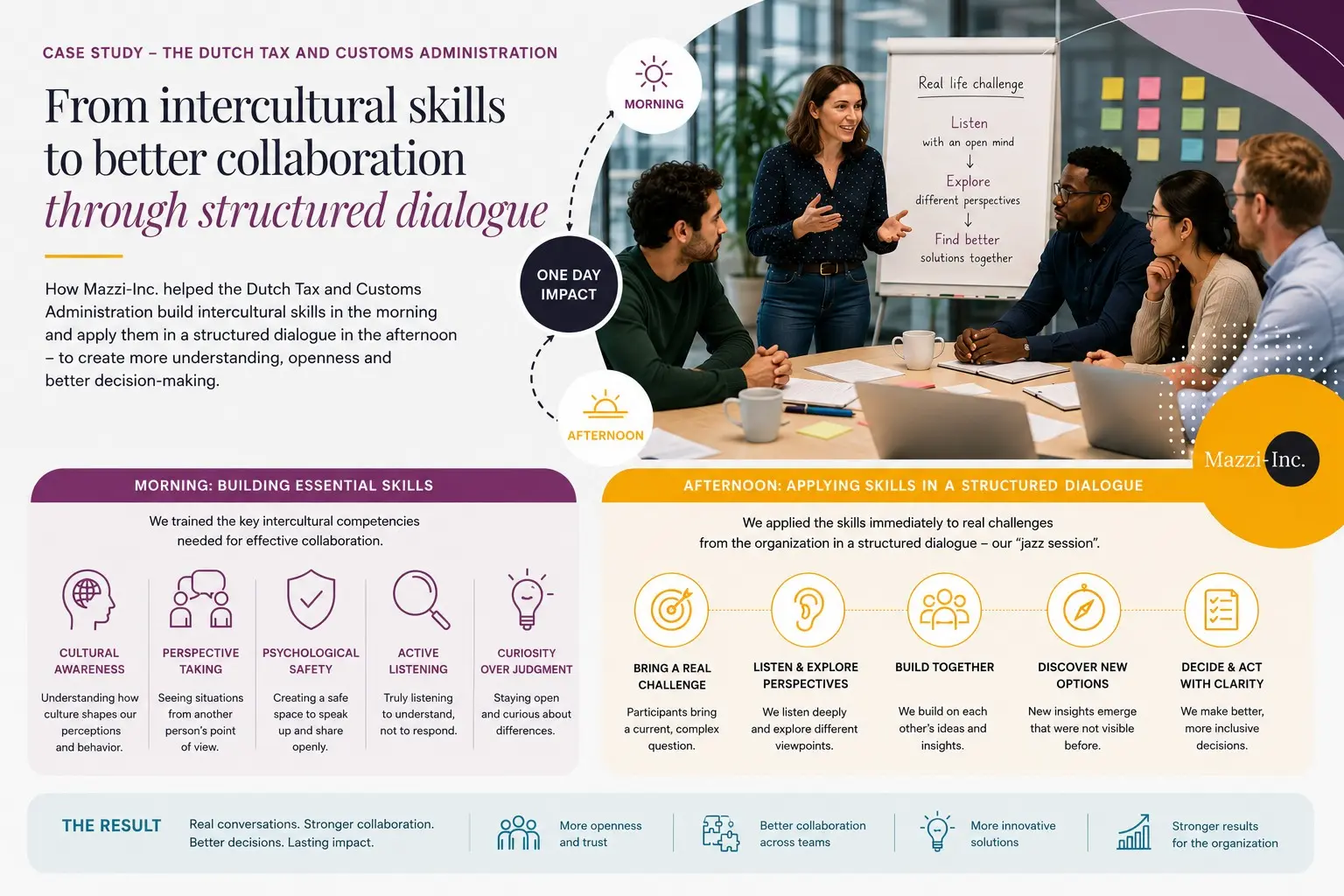
Together with the internal working group Mens, Mazzi-Inc. designed an intervention that intentionally moved away from conventional soft skills training. Instead of a multi-day offsite disconnected from daily reality, the program was built as an intensive one-day experience in which participants immediately applied new skills to real organisational challenges.
The morning session focused on intercultural competencies. Not culture in the narrow sense of nationalities or international business etiquette, but culture as the collection of assumptions, norms, habits, and interpretations that influence how people communicate, collaborate, and make sense of each other’s behavior.
Participants explored how quickly people interpret situations through their own frame of reference. What feels clear and efficient to one person may come across as confrontational or dismissive to someone else. What one colleague experiences as involvement and commitment may feel like control or resistance to another. These differences often remain invisible beneath the surface of organisational life — yet they strongly shape collaboration and trust.
Through interactive exercises, reflection, and real-life examples, participants developed cultural awareness, perspective taking, and psychological safety. The goal was not merely to create awareness, but to strengthen curiosity: the ability to pause judgment and genuinely explore what may lie behind another person’s behavior or perspective.
From training to application
What made the intervention particularly powerful happened during the afternoon session.
Rather than working with fictional cases or abstract simulations, participants immediately applied their newly developed skills to real organisational challenges from their own working environment. For this purpose, Mazzi-Inc. facilitated a structured dialogue methodology — internally referred to as a jazz session.
The metaphor was intentional. Much like jazz musicians improvise together without relying on a rigid script, participants learned to collaborate through listening, building on each other’s perspectives, and jointly exploring complex issues instead of defending fixed positions.
For many participants, this proved both confronting and enlightening.
In most organisational conversations, people quickly move toward solutions, opinions, or defending their own perspective. During the structured dialogues, however, participants first learned to slow down. They practiced listening not in order to respond, but in order to understand. Different perspectives became visible, hidden assumptions surfaced, and participants experienced how much valuable information is often lost in everyday meetings and decision-making processes.
The cases discussed during the sessions came directly from the organisation itself. Topics included collaboration between departments, stakeholder communication, hybrid work dynamics, decision-making processes, and the tension between strategy and execution. Because the challenges were real and immediately recognizable, participants felt genuine ownership of the conversations.
When culture becomes visible in behavior
Throughout the sessions, participants increasingly realized that culture change does not emerge simply by defining new organisational values. Real change begins when people experience that different behavior leads to better conversations, stronger understanding, and more effective collaboration.
And that is exactly what happened during the structured dialogues.
Participants discovered how psychological safety directly influences whether people feel comfortable asking questions, expressing uncertainty, or challenging assumptions. They experienced how perspective taking reduces polarization and creates space for more thoughtful decision-making. And they learned that curiosity is often more productive than rushing toward immediate solutions.
Because the skills were directly connected to real organisational dynamics, much of the usual resistance toward soft skills training disappeared. The intervention no longer felt like an “extra” activity, but rather like an essential component of effective collaboration and organisational development.
A different way of collaborating
For Mazzi-Inc., this project once again confirmed that sustainable organisational development begins with the quality of interaction between people.
When employees learn to:
- listen more consciously;
- respond with greater curiosity;
- suspend quick judgment;
- and actively strengthen psychological safety,
organisations create space for stronger collaboration, better decision-making, and more inclusive teams.
The combination of intercultural competence training and immediate application through structured dialogue proved to be particularly powerful. Rather than merely talking about culture change, participants experienced culture change directly in practice.
And that is often where meaningful transformation truly begins.
Curious about our Intercultural Skills Training Programmes?