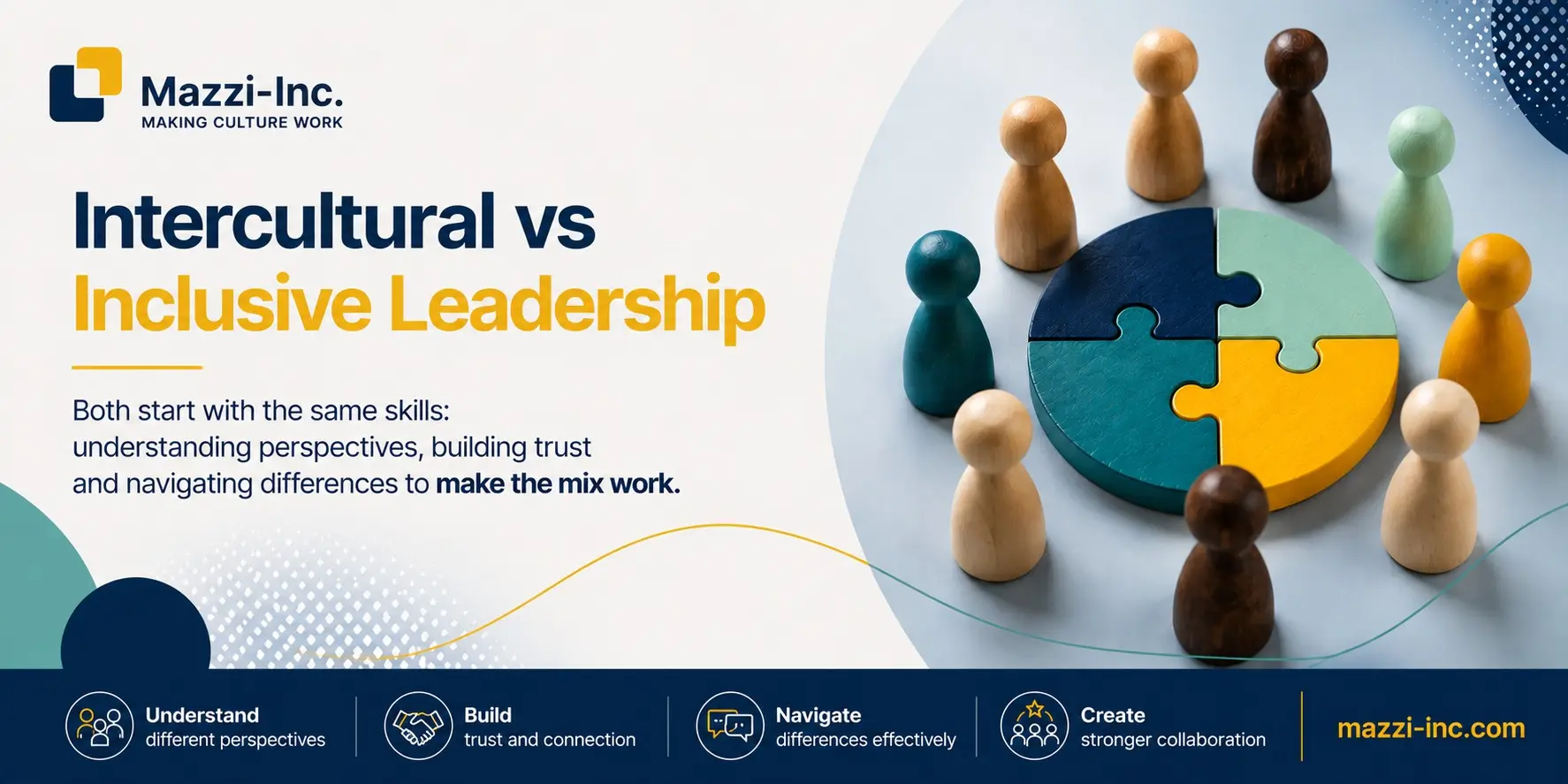
Perhaps the real question is not which type of leadership organisations need, but which capabilities leaders need to develop.
A New Leadership Model Every Few Years?
Organisations are becoming increasingly diverse. Teams bring together people with different nationalities, generations, professional backgrounds and life experiences. At the same time, the language around leadership continues to evolve.
A few years ago, much of the discussion focused on inclusive leadership. Today, intercultural leadership has become the dominant theme. New articles, leadership programmes and training courses often present it as a distinct set of competencies.
But is it really?
Or are we simply looking at the same underlying capability from a different perspective: the ability to lead effectively in environments where people think, communicate and work differently?
Differences Are Not the Problem
When collaboration becomes difficult, organisations often point to diversity itself as the cause. Teams are international, employees have different expectations or people simply communicate in different ways.
Yet differences themselves are rarely the real issue. The challenge begins when people interpret the same situation differently. What one person experiences as an open discussion may feel confrontational to someone else. Behaviour intended as engagement can easily be interpreted as interference. Different perspectives are natural—but without understanding them, collaboration becomes harder.
This is where effective leadership begins. Not by eliminating differences, but by understanding them.
From Cultural Intelligence to Inclusion
Research on inclusive leadership consistently highlights similar qualities. Inclusive leaders are curious about other perspectives, aware of their own assumptions, create psychological safety and ensure that different voices are genuinely heard.
When these qualities are compared with the competencies associated with intercultural leadership, something interesting emerges. Intercultural leadership also relies on curiosity, cultural intelligence, self-awareness, adaptability and the ability to adjust communication to different people and situations.
Perhaps leaders are not developing two different competencies after all. Perhaps they are learning to apply the same underlying capabilities across an increasingly broad range of differences.
The Foundation Is Intercultural Competence
At Mazzi-Inc., we believe that intercultural competence is about much more than knowledge.
Knowledge helps professionals recognise differences, but it only becomes valuable when people learn to observe situations carefully, explore multiple perspectives and consciously choose behaviour that fits the context.
The next step is putting that behaviour into practice: listening before responding, adapting communication, building trust and relationships, and remaining open to feedback in order to continuously improve.
It is this combination of knowledge, cognitive skills, behavioural skills and a curious attitude that forms the foundation of effective leadership in diverse teams.
Inclusive Leadership Is Visible Behaviour
When leaders develop these competencies, something changes in everyday collaboration. Meetings do not become more inclusive simply because inclusion appears in the organisation's values. They become more inclusive because leaders intentionally create space for different perspectives.
Psychological safety does not emerge through policies alone. It grows when leaders demonstrate that questions, uncertainty and different opinions are genuinely welcomed.
Inclusive leadership is therefore not a separate leadership model. It is the visible expression of well-developed intercultural competence.
Reflection
Perhaps the question within your organisation is not whether leaders should develop intercultural leadership or inclusive leadership.
Perhaps the more relevant questions are:
- How curious are our leaders about perspectives that differ from their own?
- To what extent do employees feel safe to express a different opinion?
- Are our leaders developing not only knowledge about differences, but also the capabilities to work with those differences effectively?
Final Thought
Intercultural leadership and inclusive leadership are not competing leadership models. They complement one another.
Intercultural leadership develops the capabilities needed to recognise, understand and navigate differences effectively. Inclusive leadership is what those capabilities look like when they are consistently translated into everyday leadership behaviour.
Ultimately, leadership is not about choosing the right label. It is about developing the capability to turn differences into stronger collaboration.
Curious about our Intercultural Leadership Training Programmes?