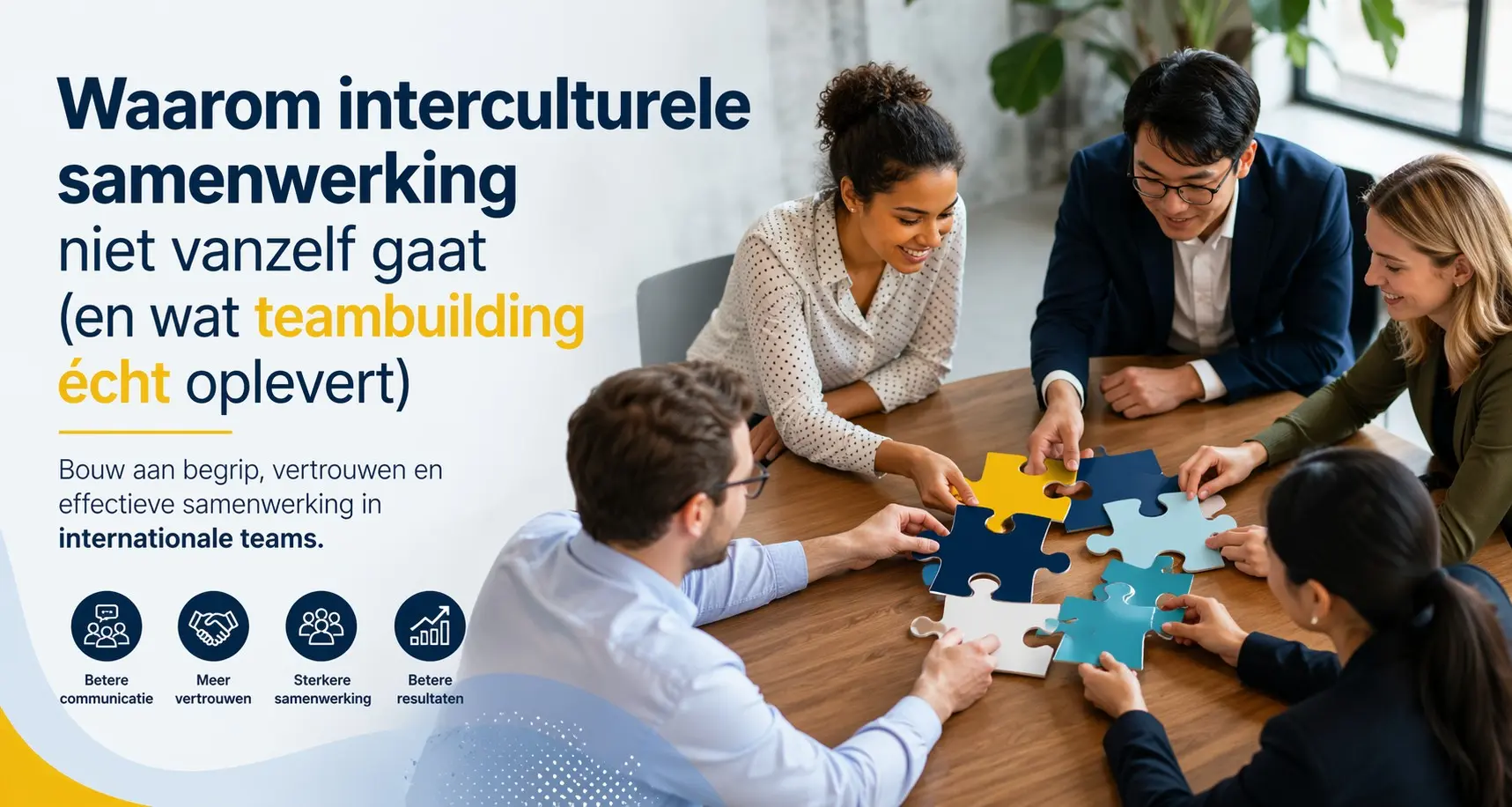
Why collaboration in international teams is not as straightforward as it seems
You have a team of capable, motivated professionals. Everyone is working toward shared goals, deadlines are met, and on paper, everything looks aligned. And yet, collaboration does not always feel effortless. Meetings take more energy than expected. Misunderstandings keep resurfacing. And that sense of real connection—the kind that makes teamwork flow—sometimes feels just out of reach. In international teams, this is not unusual. Not because people are unwilling to collaborate, but because they each bring their own assumptions about what collaboration looks like. Intercultural collaboration requires more than alignment on goals. It requires awareness of differences that are often invisible, yet shape everyday interactions in powerful ways.
Teambuilding in international teams: beyond the surface
In many organisations, teambuilding is still seen as something additional—an activity, a workshop, or a team day. Valuable, certainly, but rarely enough to address the real dynamics at play. In international teams, teambuilding needs to go deeper. It is not just about creating a sense of connection, but about understanding how collaboration actually works within the team. That means exploring how people communicate, how decisions are made, and how trust is built. These are not always visible on the surface, yet they shape how team members interpret each other’s behavior. Only when these underlying dynamics become explicit does space open up for more effective collaboration.
What happens beneath the surface of collaboration
Many of the challenges teams experience are not the result of lack of effort or commitment. More often, they stem from different frames of reference. Questions that seem straightforward can have very different answers, depending on cultural background. What does “clear communication” actually mean? When is someone considered proactive? How direct can feedback be? And what does silence in a meeting signal—agreement, reflection, or hesitation? These differences are rarely discussed openly, yet they strongly influence how behavior is interpreted. Without awareness, this easily leads to misunderstandings, frustration, and reduced engagement. And that is often where collaboration starts to feel strained—even when intentions are positive.
Cultural awareness as the foundation for collaboration
Effective intercultural collaboration begins with cultural (self-)awareness. Not as an abstract concept, but as a practical skill. It involves understanding your own preferences and assumptions, recognizing those of others, and being able to move between them. When teams develop this awareness, something shifts. Behavior is less quickly judged and more often understood. Conversations become more open and constructive. And gradually, trust begins to grow. That trust is not a byproduct—it is a prerequisite for effective collaboration.
Why language alone is not enough
In international teams, language is often seen as the primary barrier. And it makes sense—having a shared language does make communication easier. But language alone does not guarantee understanding. People can use the same words and still mean different things. A phrase like “that’s interesting” might express genuine enthusiasm in one context, while in another it signals doubt or polite disagreement. This is where culture comes in. Language provides the words, but culture shapes their meaning. When teams develop both language skills and cultural awareness, communication becomes more precise, more nuanced, and ultimately more effective.
From better understanding to better results
When intercultural collaboration improves, the impact is immediately visible. Communication becomes clearer, with less room for interpretation. Trust strengthens, making collaboration more fluid. Teams align more quickly, and decisions are made with greater confidence. The result is not that people work harder—but that they work better together. And that difference shows in performance.
How to strengthen intercultural collaboration in practice
Improving collaboration does not require a complete transformation overnight. It often starts with small, deliberate steps. It begins by making implicit expectations explicit. Teams benefit from discussing how they communicate, how they give feedback, and how decisions are made. Not because there is one correct way, but because clarity reduces friction. It also helps to check interpretations more actively. Asking whether something is a proposal or a final decision, for example, can prevent unnecessary confusion. Providing context becomes equally important. Especially in international teams, explaining the intention behind a message can make a significant difference. And perhaps most importantly, it requires reflection. What feels obvious or “normal” to one person may not be so for another.
Reflection: how does your team collaborate?
Take a moment to consider your own team. Where do misunderstandings tend to arise? Which differences remain unspoken, yet still influence collaboration? And how do you respond when someone behaves in a way that feels unfamiliar? These questions often reveal the dynamics that shape collaboration more than any formal process ever could.
Teambuilding as a driver for real change
Teambuilding becomes truly impactful when it moves beyond activities and focuses on behavior. It is not just about doing something together, but about understanding how you work, why you work that way, and how that differs across the team. When culture and communication are integrated into teambuilding, the effect goes beyond the moment itself. It leads to lasting changes in how people interact and collaborate. And that is where real progress happens.
Strengthening intercultural collaboration with Mazzi-Inc.
At Mazzi-Inc., we support organisations in making intercultural collaboration tangible and practical. We help teams and leaders develop cultural awareness, improve communication, and strengthen collaboration in international contexts. Always practical, relevant, and directly applicable.
Ready to strengthen collaboration in your team?
Improving intercultural collaboration starts with insight—but it creates impact through behavior. Curious how your team can collaborate more effectively in an international context? We’d be happy to explore this with you. Get in touch and discover how we help organisations turn differences into strengths.
Care to learn more about our Intercultural Collaboration Training Programmes?