Imagine that someone in your team is offered an opportunity that would be very valuable for their own development. It could mean taking on an interesting project, attending an international programme or moving into a role with greater responsibility.
The opportunity is clearly positive for that person. At the same time, the team is already under pressure. Their absence would create additional work for colleagues, and someone else would need to take over part of their responsibilities.
Should the person take the opportunity?
There is no obvious answer. One person may first consider the individual's right to pursue their own development and expect people to take responsibility for their own choices. Another may first think about the effect on the team and whether the decision is fair to the people who will have to absorb the additional workload.
Both perspectives can be reasonable. The difference lies in whose interests come into focus first when individual and collective needs have to be balanced.
What do we consider when interests compete?
Every organisation brings together people who are individuals in their own right while also being members of teams, departments and wider communities. These different forms of belonging often work well together, but they can also create situations in which individual interests and group interests do not point in exactly the same direction.
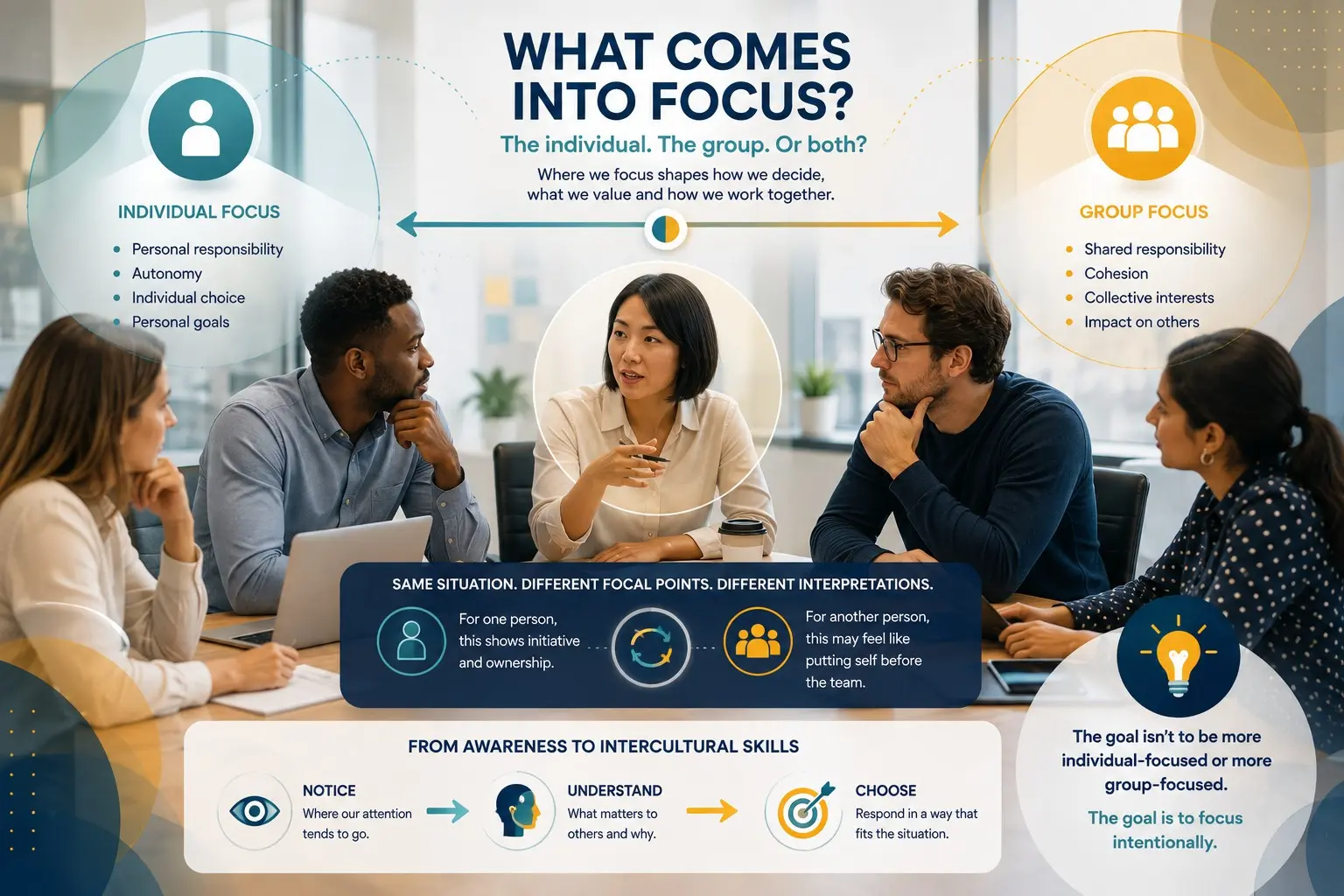
Some people naturally start with the individual. They may place importance on personal responsibility, individual choice and the freedom to pursue their own goals. From this perspective, taking ownership of a decision can be an important contribution to the group, even when an individual's interests do not completely align with those of the team.
Others may first consider the group. They may pay more attention to shared responsibility, team cohesion and the consequences a decision could have for other people. From this perspective, taking the wider interests of the group into account can be an important part of acting responsibly.
Neither approach is inherently better. What differs is where attention goes first when individual and collective interests need to be weighed against one another.
When individual responsibility meets collective responsibility
Consider a team that needs to decide how to distribute an additional workload.
One colleague may believe that people should primarily take responsibility for their own priorities and communicate clearly about what they can and cannot take on. From this perspective, individual ownership creates clarity and prevents people from becoming overly dependent on the group.
Another colleague may start from a different point. They may be more concerned with how the workload affects the team as a whole and whether everyone is contributing fairly. Finding a solution that protects the team's capacity may feel more important than ensuring that each individual can pursue their preferred option.
Both may be trying to create a fair outcome. They simply have different ideas about where responsibility begins and whose interests should be considered first.
The same difference can become visible when responsibilities are assigned. An individual-focused approach may emphasise clear personal ownership and accountability, while a group-focused approach may place greater emphasis on shared responsibility and the contribution of the wider team.
What happens when someone disagrees?
The difference can become even more visible when someone expresses an opinion that is not shared by the rest of the team.
For one person, openly stating a different view may be an important way of contributing to the group. A team benefits from hearing individual perspectives, even when they challenge what others currently think.
Another person may first consider what expressing that disagreement could do to the relationships within the team. They may be concerned that an openly expressed difference could create tension or weaken cohesion, and may therefore look for a way to raise the issue that takes the wider group into account.
How people approach disagreement also plays a role here. While one person may see open discussion as a way to move forward together, another may be more attentive to its impact on relationships within the team. We explore this further in our blog ‘When Does Disagreement Make a Team Stronger?’.
Neither person necessarily values the team more or less. They may simply be paying attention to different things at the same moment: the value of the individual's contribution or the effect of that contribution on the group.
This can also influence how achievement is recognised. Some people are comfortable highlighting individual contributions and performance, while others prefer to emphasise what the team has achieved together.
When preferences meet
Different focal points can easily lead to personal interpretations of behaviour.
An individual-focused colleague may experience a group-focused approach as avoiding personal responsibility or making decisions more complicated than necessary. A group-focused colleague may experience the same behaviour as insufficiently considerate of others or as placing personal interests above those of the team.
These different expectations can also influence how people build trust and professional relationships. What makes a working relationship feel dependable: clear individual commitments or a sense of connection with the people involved? We explore this in our blog ‘When Does a Professional Relationship Become a Good Relationship?’.
Both interpretations may feel convincing from the perspective of the person making them. But neither necessarily tells the whole story. The difference may simply reflect which interests each person is considering first. Once we recognise that, there is more room to become curious about what the other person is taking into account before deciding what their behaviour means.
This is particularly relevant in international teams, where different expectations about individual and collective responsibility can exist alongside one another. A behaviour that looks self-evident from one perspective may look inconsiderate, overly dependent or unnecessarily complicated from another.
The challenge is not to decide which perspective is correct, but to understand what each perspective is trying to protect.
From awareness to intercultural skill
Recognising these differences is a first step. The real intercultural skill develops when we can use that awareness in everyday situations: when making decisions, assigning responsibility, expressing opinions, recognising achievement or deciding what is fair.
Explore these preferences in more detail on our Cultural Profiler dimension page Focal Point — Individual vs. Group.
The goal is not to become more individual-focused or more group-focused. It is to recognise what the situation requires, understand which interests others may be considering and choose how to respond appropriately.
Sometimes the situation may call for clear individual ownership. At other times, the wider consequences for the team or community may deserve greater attention. Often, both matter at the same time.
The skill lies in being able to see the different interests in the situation rather than assuming that the one you notice first is the only one that matters.
What does this mean for your team?
The next time a decision affects both an individual and the wider team, it may be worth noticing what you consider first.
Do you instinctively ask what the decision means for the people directly involved? Or do you first consider what it means for the team as a whole?
And what happens when colleagues start from different points?
Whose interests come into focus first in your team — and what happens when those interests do not fully align?
These questions can open an important conversation about responsibility, decision-making and what your team considers fair.
When team members learn to recognise which interests others take into account, they can respond more consciously to differences in responsibility and decision-making. In our Intercultural Collaboration training, participants practise the skills needed to bring different perspectives together constructively.
The Mazzi-Inc. Cultural Profiler makes cultural preferences visible that may influence how people approach responsibility, decision-making, collaboration and the balance between individual and collective interests.
Want to explore how your team balances individual and collective interests?
Discover the Mazzi-Inc. Cultural Profiler