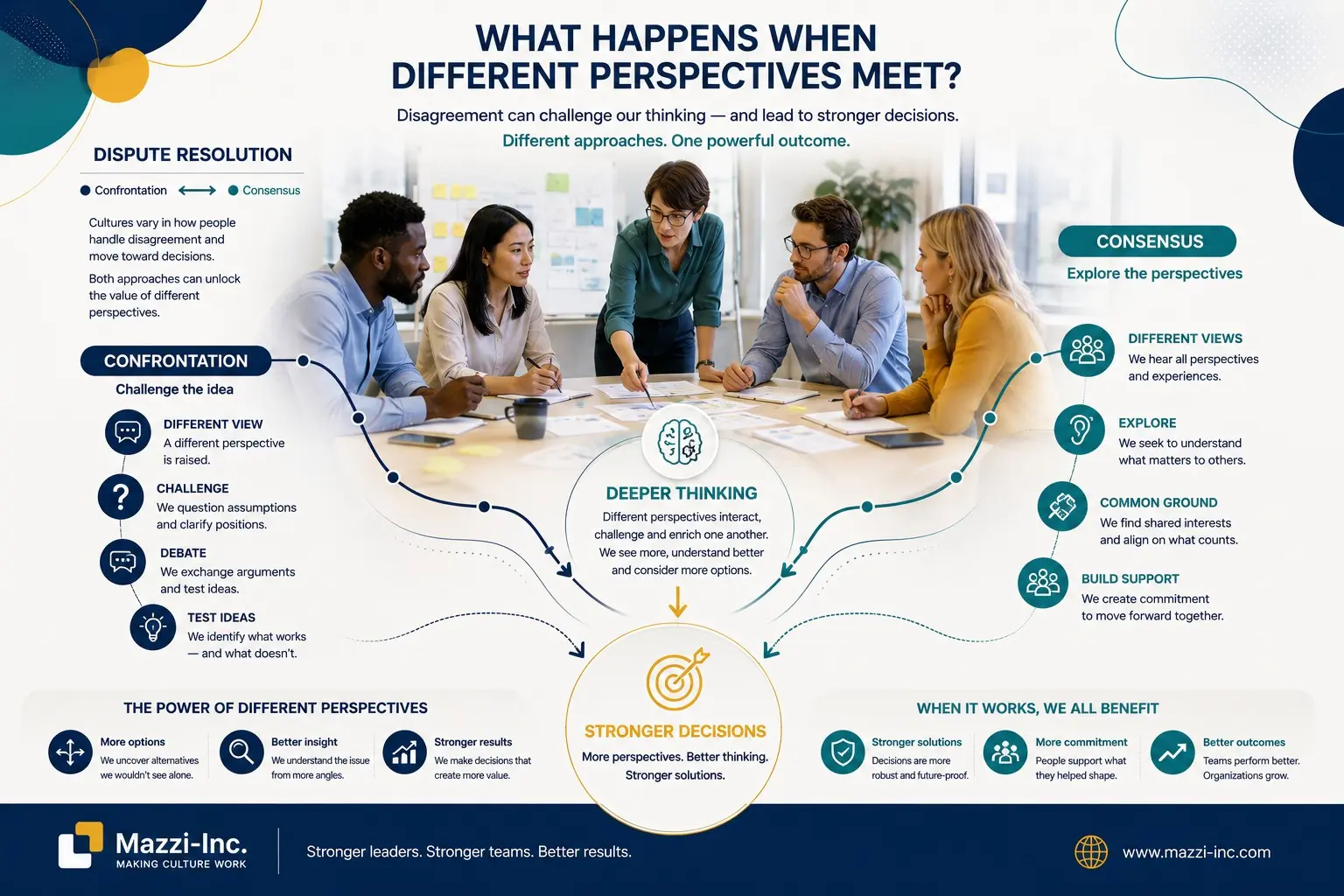
Imagine a team discussing an important proposal. The discussion is going well until one colleague openly challenges the idea. They question some of the assumptions, point out possible weaknesses and suggest an alternative approach.
For one person in the room, this is exactly what a good discussion should look like. Different perspectives are being brought into the open, and challenging ideas is an important way to reach a better decision.
Another colleague experiences the same situation differently. The discussion suddenly feels uncomfortable. Why challenge the proposal so directly? Would it not be more constructive to first understand the different concerns and look for common ground?
Both colleagues want the team to make a good decision. Yet they have different expectations about how disagreement should be handled. And that difference can have a significant influence on how teams work together.
Why do we disagree about disagreement?
Disagreement is a natural part of collaboration. People bring different experiences, knowledge, priorities and perspectives to their work. Even when they share the same objectives, they may interpret a situation differently or have different ideas about the best way forward.
These differences can be valuable. They can reveal assumptions, challenge established ways of thinking and bring information into the discussion that might otherwise remain unnoticed.
But having different perspectives does not automatically lead to better decisions. Much depends on what happens when those perspectives meet.
For some people, a constructive discussion means bringing disagreement into the open. They are comfortable challenging ideas directly and expect others to do the same. By testing arguments and questioning assumptions, they believe the team can identify weaknesses and arrive at stronger solutions. From this perspective, avoiding confrontation may mean leaving important issues unresolved.
Others believe that a constructive discussion begins with understanding the different perspectives involved. Rather than immediately challenging an idea, they may first explore the reasons behind it, identify shared interests and look for common ground. For them, building mutual understanding and support is an important part of reaching a sustainable solution.
The interests people consider first may also influence their approach. One person may place particular value on the opportunity to express an individual perspective, while another may focus more on the consequences for the team as a whole. We explore this in our blog ‘Whose Interests Come First?’.
This is the distinction between Confrontation and Consensus.
Both approaches can involve difficult conversations. A consensus-oriented person does not necessarily avoid conflict, just as someone who prefers confrontation is not necessarily interested in winning an argument.
The difference lies in how people believe disagreement can best be used to move forward.
Neither approach is inherently better. Both can contribute to effective collaboration. The difficulty arises when people assume that their own way of handling disagreement is the obvious or appropriate one.
To explore these preferences in more detail, read our Cultural Profiler dimension page: Dispute Resolution — Confrontation ↔ Consensus.
When a constructive challenge feels like a personal attack
Imagine that a project team is discussing a new way of working.
One colleague says: “I don't think this will work. We haven't considered the consequences for our customers.”
The intention may be entirely constructive. This person wants to test the proposal before the team commits to it. They expect others to challenge their concerns in return, and they may see this exchange as a normal part of reaching a sound decision.
Another colleague may interpret the same comment as unnecessarily confrontational. Perhaps the proposal was developed with considerable effort, or perhaps the colleague believes that concerns should first be explored through questions rather than direct criticism.
The first person may wonder why others are so reluctant to speak openly. The second may wonder why someone needs to make the discussion uncomfortable.
Neither interpretation necessarily tells the whole story.
What one person experiences as intellectual challenge, another may experience as criticism. What one person sees as careful relationship management, another may interpret as avoiding the issue.
The disagreement is no longer only about the proposal. It is also about what people consider an appropriate way to disagree.
When agreement comes too quickly
Different expectations about disagreement can also affect what happens when nobody openly challenges an idea.
Imagine a manager presenting a proposed decision to an international team. The manager explains the reasoning and invites comments. After a brief discussion, everyone appears to agree. The manager may conclude that the team supports the proposal. But what does that agreement actually mean?
Some team members may genuinely be convinced. Others may still have concerns but prefer to raise them privately, explore them with colleagues first or wait until they have a better understanding of the wider implications.
Someone may also feel that challenging the proposal openly would be inappropriate because of the relationship, the hierarchy or the circumstances.
Expectations about the relationship between managers and employees also play a role. Not everyone considers it equally appropriate to openly challenge a manager. We explore these different expectations in our blog ‘What Does Good Leadership Look Like?’.
The absence of visible disagreement therefore does not necessarily mean that everyone sees the situation in the same way. This is particularly important when decisions require commitment from the whole team.
A decision can appear to have broad support while important questions remain unspoken. Equally, a lengthy debate can create the impression of disagreement even when everyone is working towards the same outcome.
The challenge is to understand what is actually happening rather than relying only on what is immediately visible.
When preferences meet
When people have different expectations about disagreement, misunderstandings can develop surprisingly quickly.
Someone who prefers direct confrontation may experience a consensus-oriented colleague as hesitant, indecisive or unwilling to address difficult issues.
The consensus-oriented colleague may experience the same person as impatient, overly forceful or more interested in winning an argument than finding a solution everyone can support.
Both may believe they are contributing constructively. The difference lies partly in what they think helps a team move forward.
One person may believe that openly challenging ideas leads to stronger decisions. Another may believe that understanding concerns and building support creates the conditions for effective implementation.
And both may have a point. A team that avoids difficult conversations may overlook important risks or alternatives. A team that challenges every idea without paying attention to relationships may find that people become less willing to contribute.
Effective collaboration therefore requires more than choosing between confrontation and consensus. It requires understanding what the situation needs.
From awareness to intercultural skill
Recognising different preferences is an important first step. The real intercultural skill develops when we can use that awareness to influence how we respond.
When someone challenges an idea directly, we can avoid immediately interpreting the challenge as hostility. Instead, we can consider what the person is trying to achieve and what information their challenge might reveal.
When someone seems reluctant to disagree, we can avoid assuming that they have nothing to contribute. We might create another opportunity for them to share their perspective or ask questions that make it easier to explore concerns.
And when a discussion becomes difficult, we can pay attention not only to the arguments being made, but also to how people are experiencing the interaction.
Sometimes a team needs more direct challenge. At other times, it needs more time to explore concerns, understand different perspectives and build common ground.
Often, it needs both. For example, a team might explicitly agree to challenge the assumptions behind a proposal before discussing how to build support for the eventual decision. This creates room for critical thinking without losing sight of the relationships needed to move forward together.
The goal is not to become more confrontational or more consensus-oriented. It is to recognise how different people approach disagreement, understand what the situation requires and consciously choose a response that helps the team make progress.
What does this mean for your team?
The next time a discussion becomes uncomfortable, it may be worth asking what is actually causing the tension.
Do people disagree about the substance of the decision? Or do they have different expectations about how disagreement should be expressed?
Does everyone feel able to challenge an idea? And does everyone understand what is expected when someone does?
How does your team know whether apparent agreement reflects genuine support?
These questions can open an important conversation about how your team uses different perspectives when solving problems and making decisions.
Different perspectives create the potential for better decisions. How we work with disagreement determines whether that potential is realised.
Working constructively with disagreement requires more than recognising different preferences. It also takes skills that help team members make room for different perspectives and reach decisions they can support together. Participants practise these skills in our Intercultural Collaboration training.
The Mazzi-Inc. Cultural Profiler makes cultural preferences visible that may influence how people approach disagreement, communicate, collaborate and make decisions.
Want to explore how different approaches to disagreement influence collaboration in your team?
Discover the Mazzi-Inc. Cultural Profiler