Imagine meeting a new business partner for the first time.
You exchange greetings and sit down for the meeting. One person opens the laptop and goes straight to the agenda. There is a lot to discuss, and getting to the point feels like the most respectful use of everyone's time.
The other person has a different expectation. Before discussing the business, they want to have a coffee, ask about the other person's background and find some common ground. For them, getting to know each other is an important part of creating the conditions for a good working relationship.
Neither person is necessarily being more or less professional.
But one may leave the meeting thinking:
“That was efficient.”
The other may leave thinking:
“We haven't really got to know each other yet.”
These different expectations also relate to how people approach time. What feels efficient to one person may leave another feeling that too little attention is being paid to the relationship. We explore these different perspectives further in our blog ‘What Does Being On Time Mean?’.
The difference is not simply about being friendly or businesslike. It is about what people expect from a professional relationship and what they need before they feel comfortable working closely with someone.
When does a professional relationship start to feel reliable?
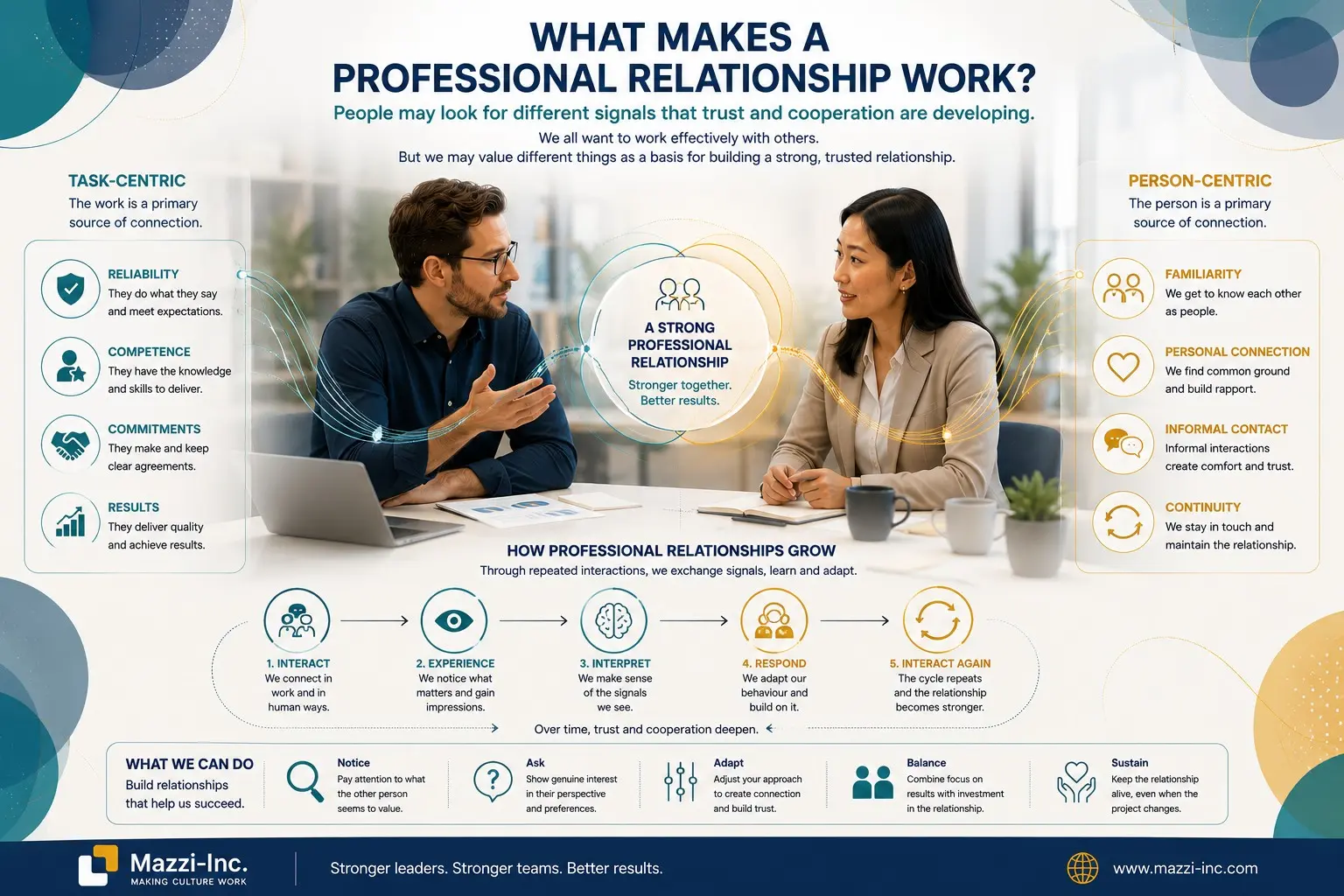
Professional relationships are an essential part of working together. We rely on colleagues, clients and partners to exchange information, make decisions and achieve shared goals. Yet people do not always look for the same things as a professional relationship develops.
For some people, reliability emerges primarily from the work itself. They pay attention to whether someone does what they say they will do, keeps commitments and demonstrates competence. Over time, these experiences provide evidence that the other person can be relied upon.
For others, something more personal may be important as well. Getting to know the person behind the professional role, having informal conversations and developing familiarity can contribute to the sense that the relationship is dependable.
Both approaches can lead to strong professional relationships. The difference lies partly in which signals people recognise as evidence that they can rely on someone.
When efficiency feels distant
Consider a first meeting between a client and a new supplier.
The client arrives with a clear agenda and expects the conversation to focus on the project. The supplier, however, begins by asking about the client, the organisation and their experience. They spend some time talking before getting into the details of the work.
The client may wonder why they are not getting to the point. The supplier may wonder why the client seems so distant. Neither necessarily has the wrong intention. The client may be showing respect by being efficient. The supplier may be showing respect by taking the time to create a connection.
The same difference can appear with colleagues. One person may feel that a new working relationship develops naturally once they start working together. Another may feel that effective cooperation is easier once there has been an opportunity to get to know the other person.
For one, the work provides the basis for the relationship. For the other, the relationship provides an important basis for the work.
What do we recognise as evidence of trust?
This difference becomes particularly interesting because people may pay attention to different signals as a professional relationship develops.
A task-centric colleague may notice whether someone delivers what was agreed, responds reliably and demonstrates professional competence. When these expectations are consistently met, confidence in the relationship can grow.
A more person-centric colleague may also pay attention to familiarity and personal connection. Do I know this person? Do I have a sense of who they are beyond their professional role? Have we developed enough of a connection for me to feel comfortable relying on them?
Both may be looking for the same thing: confidence that the relationship is dependable. They may simply arrive at that confidence through different experiences.
This can also become visible when networking or working with clients and partners. For some people, staying in contact is closely connected to ongoing work. When there is no immediate business to discuss, there may be little reason to get in touch.
For others, regular informal contact is part of maintaining the relationship itself. A quick message, a coffee or a conversation unrelated to the current project can help preserve the familiarity and connection that support cooperation over time.
When relationship-building is misunderstood
This is where different expectations can easily become personal.
Someone with a more task-centric preference may experience a strong focus on personal connection as unnecessary, inefficient or distracting from the purpose of the relationship.
A more person-centric colleague may experience a quick move into business as cold or distant. They may wonder whether the other person is genuinely interested in developing a relationship that can support cooperation over time.
Communication style can reinforce these impressions. A direct, businesslike way of communicating may come across very differently from how it was intended. We explore this in our blog ‘When “Being Clear” Means Different Things Across Cultures’.
Both may believe they are behaving appropriately. The difference lies partly in what they consider evidence of a strong professional relationship.
For one person, reliability and professional performance may provide a strong basis for confidence. For another, personal connection and familiarity may be equally important. Neither interpretation necessarily tells the whole story.
It is not about being “more relationship-oriented”
This is an important distinction.
It can be tempting to describe someone who enjoys informal conversations and personal connection as more relationship-oriented, and someone who goes straight to business as less interested in relationships. But that misses the point.
A task-centric person can care deeply about professional relationships. They may simply see reliability, competence and keeping commitments as the experiences through which a strong relationship develops.
A person-centric colleague can care just as much about getting the work done. They may see personal connection and familiarity as important experiences through which cooperation becomes more comfortable and dependable.
Both can be highly committed to the relationship. They simply have different ideas about what makes a professional relationship work.
From awareness to intercultural skill
Recognising these differences is a first step. The real intercultural skill develops when we can use that awareness in everyday interactions.
Explore these preferences in more detail on our Cultural Profiler dimension page Professional Relationships — Task-centric vs. Person-centric.
When meeting someone for the first time, we can consider whether moving straight into the business is the most effective approach for this particular person and situation.
As a working relationship develops, we can pay attention to the signals the other person seems to value rather than assuming that our own signals are universal. When working with clients, partners or colleagues over a longer period, we can also recognise that staying in touch may have a different meaning for different people.
The goal is not to become more task-centric or more person-centric. It is to recognise what the situation requires, understand how others may approach the relationship differently and consciously choose how to respond. That may mean allowing a little more time for informal conversation. Or it may mean making sure that a relationship is supported by clear commitments, reliable delivery and professional competence.
The skill lies in recognising what the other person may need — without assuming that their preference is the same as yours.
What does this mean for your team?
The next time a colleague or business partner approaches a professional relationship differently from you, it may be worth pausing before deciding what their behaviour means. Perhaps they are wasting time. Perhaps they are being distant. But perhaps they simply have a different idea of what makes a professional relationship dependable and effective.
What makes you feel that you can rely on someone in a professional relationship?
Is it primarily their reliability, competence and ability to keep commitments? Or does it also matter that you know the person behind the professional role? And what happens when the people you work with have very different answers to those questions?
These questions can open an important conversation about how professional relationships develop within your team — and what people need from one another to work effectively together.
When team members better understand what trust and a good working relationship mean to one another, they can shape their collaboration more consciously. In our Intercultural Collaboration training, participants practise the skills needed to do this.
The Mazzi-Inc. Cultural Profiler makes cultural preferences visible that may influence how people communicate, collaborate, develop professional relationships and come to rely on one another.
Want to explore how your team approaches professional relationships?
Discover the Mazzi-Inc. Cultural Profiler