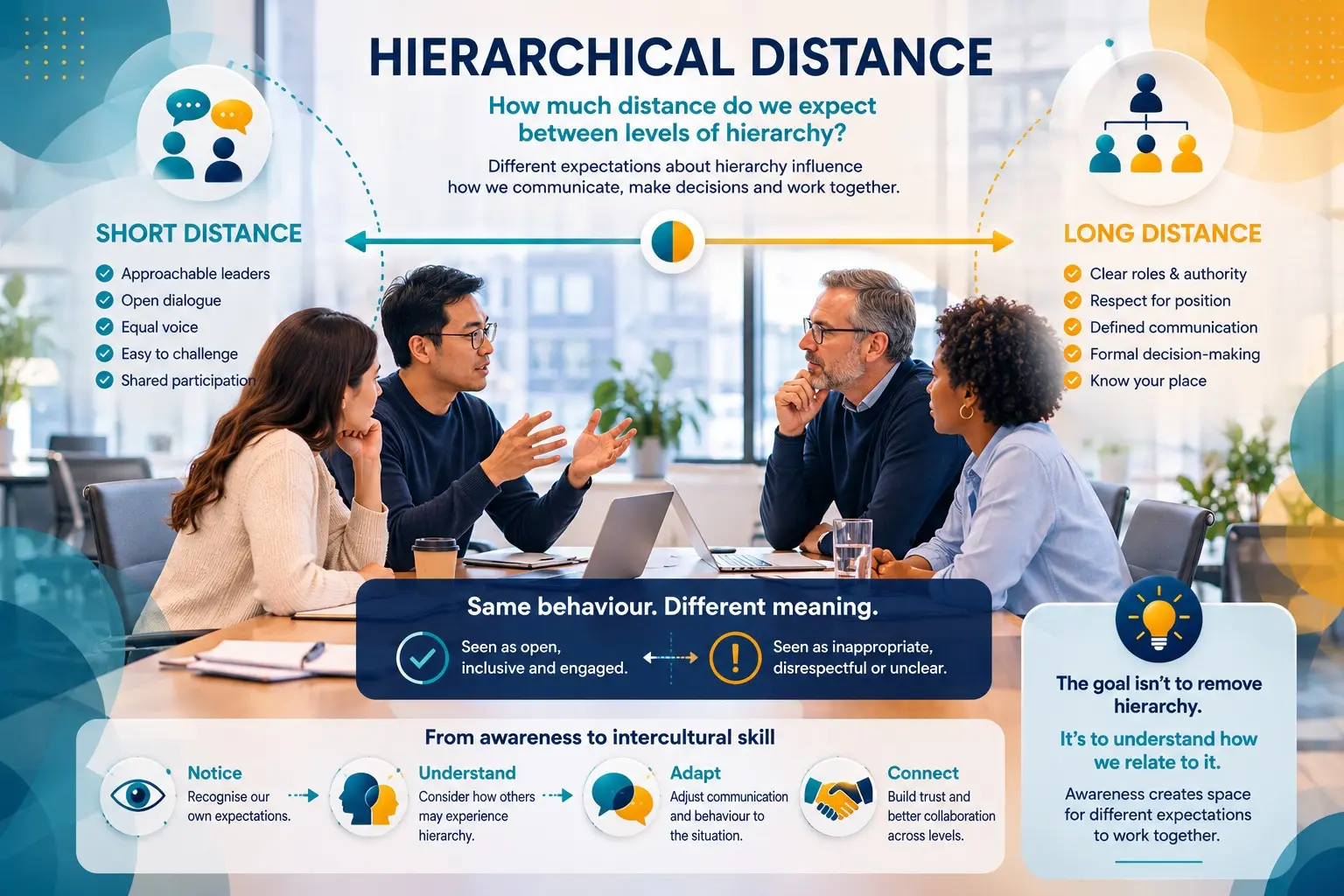
Imagine a manager who starts a meeting by asking everyone for their opinion. The manager openly shares their own thinking, invites people to challenge assumptions and makes it clear that disagreement is welcome.
For some people, this is exactly what good leadership looks like. A manager who is approachable and willing to listen creates an environment in which people can contribute openly and take responsibility for their work.
For others, the same behaviour may raise different questions. If the manager is asking everyone to challenge their decisions, who is ultimately responsible for deciding? Does a leader not have a particular role and authority within the organisation? And if there is a disagreement, should that really be discussed openly in front of everyone?
Neither reaction necessarily reflects a different attitude towards leadership. People may simply have different expectations about the distance that should exist between different levels of hierarchy.
How much distance should there be?
Hierarchy is part of almost every organisation. People have different roles, levels of responsibility and areas of authority, and these differences inevitably influence how people communicate and make decisions. What varies is how much distance people expect between those different levels.
Some people are comfortable with relatively close relationships across levels of hierarchy. They may expect managers to be approachable and feel comfortable asking questions, expressing a different opinion or challenging a decision. From this perspective, a relatively informal relationship between a manager and an employee does not necessarily reduce the manager's authority. It may even make it easier for people to contribute and take responsibility.
Others may see a clearer distinction between hierarchical levels as appropriate. They may expect people in senior positions to carry a different level of authority and responsibility, and therefore consider certain forms of communication more appropriate than others. In such an environment, challenging a senior person openly may not be the preferred way of contributing, even when disagreement is possible.
The difference is therefore not simply about whether people “like hierarchy”. It is about what they expect a hierarchical relationship to provide and how those expectations influence the way they communicate and work together.
When does participation feel appropriate?
Consider a meeting in which the manager presents a proposal and invites the team to respond.
One employee may immediately share a different perspective, ask difficult questions and openly explain why they are not convinced. They may see this as constructive participation and feel that the manager has specifically created the space for it.
Another employee may listen carefully but wait before speaking, perhaps expecting the manager or the most senior person to speak first. They may prefer to express disagreement in a different setting, or to do so more cautiously because openly challenging someone in a senior position does not feel appropriate.
Neither person necessarily has less to contribute. They may simply have different expectations about how authority and participation should work together.
Whether someone openly expresses a different opinion is not only influenced by hierarchy. It also relates to how people believe disagreement should be handled. We explore this further in our blog ‘When Does Disagreement Make a Team Stronger?’.
The same difference can become visible in decision-making. Some people expect managers to involve their teams, ask for different perspectives and explain the reasoning behind decisions. Others may see it as entirely appropriate for someone with formal responsibility to make the final decision, with employees contributing within their defined roles.
Who can approach whom?
Hierarchical expectations can also influence how comfortable people feel about approaching someone at a different level of an organisation.
Imagine that an employee has an important question for a senior leader. One person may simply send the leader a message or approach them directly. If the manager is approachable, this may be seen as efficient and constructive.
Another person may expect to follow the established line of communication and raise the question first with their direct manager. Going directly to a senior leader may feel inappropriate, particularly if it could appear to bypass someone else's responsibility.
Again, the difference is not necessarily about confidence or willingness to take responsibility. It can reflect different assumptions about what respect for organisational roles looks like in practice.
The same applies to feedback. In some contexts, openly exchanging feedback across levels may be seen as a normal part of collaboration. In others, who gives feedback to whom, how directly it is expressed and whether it is shared publicly or privately may be influenced by the hierarchical relationship.
Alongside the hierarchical relationship, communication style also plays a role. What one person experiences as clear feedback may feel too direct to someone else. We explore this further in our blog ‘When “Being Clear” Means Different Things Across Cultures’.
When preferences meet
This is where different expectations about hierarchy can easily lead to misinterpretation.
A manager who actively invites employees to challenge their ideas may be experienced by one colleague as open, confident and inclusive. Another colleague may experience the same behaviour as a lack of clear leadership, particularly if they expect the manager to provide stronger direction.
An employee who openly questions a senior colleague may be seen as engaged and constructive by one person, while another may interpret exactly the same behaviour as disrespectful or inappropriate.
Both may be responding appropriately from their own perspective.
The difference lies partly in what they believe a hierarchical relationship should provide. For one person, accessibility and dialogue may be important signs of effective leadership. For another, clarity of authority, defined responsibilities and visible respect for position may be equally important.
Once we recognise this, it becomes easier to become curious about what someone's behaviour means rather than judging it immediately according to our own expectations.
From awareness to intercultural skill
Recognising differences in expectations about hierarchy is a first step. The real intercultural skill develops when we can use that awareness in everyday situations: when leading meetings, inviting input, making decisions, giving feedback or approaching someone at a different level of the organisation.
Explore these different expectations in more detail on our Cultural Profiler dimension page Hierarchical Distance.
The goal is not to make hierarchical relationships more informal or more formal. It is to recognise what the situation requires and understand that people may experience the same behaviour differently depending on what they expect from authority and organisational roles.
A manager may therefore need to consider not only what they are inviting people to do, but also how that invitation is likely to be experienced. Asking someone to openly challenge a senior leader may feel empowering to one person and uncomfortable to another. Likewise, an employee who wants to contribute does not necessarily have to do so by adopting the most direct form of communication.
The skill lies in creating enough clarity for people to understand how they are expected to participate, while remaining attentive to the different ways in which authority and hierarchy may be experienced.
What does this mean for your team?
The next time a meeting feels unusually quiet, or unusually challenging, it may be worth asking what expectations about hierarchy are present in the room.
Are people waiting for the most senior person to speak before contributing? Do team members feel comfortable questioning decisions? Is a manager's openness experienced as an invitation to participate, or does it create uncertainty about who is ultimately responsible?
How much distance do people in your team expect between different levels of hierarchy — and what happens when those expectations differ?
These questions can open a valuable conversation about authority, participation and leadership, particularly in international teams where different expectations may come together every day.
For leaders, this requires the ability to adapt their approach to different expectations while maintaining clarity about roles and responsibilities. This is also an important part of our Intercultural Leadership training.
The Mazzi-Inc. Cultural Profiler makes cultural preferences visible that may influence how people relate to hierarchy, communicate across organisational levels, make decisions and contribute to discussions.
Want to explore how your team experiences hierarchy and authority?
Discover the Mazzi-Inc. Cultural Profiler