Most organisations spend considerable time discussing problems. Teams meet to resolve disagreements, managers bring people together to improve collaboration, and workshops are organised to address recurring challenges.
Yet some problems keep returning.
A team agrees that decisions should be made closer to where the expertise sits, but important decisions still end up with senior management. Departments commit to working more closely together, yet continue to pursue their own priorities.
Everyone seems to understand what needs to change, but familiar patterns persist.
Perhaps the problem isn't that people aren't talking enough. Perhaps it's how they are talking.
Why soft skills often meet resistance
When Per Hugander worked on culture change at Swedish bank SEB, he encountered a familiar objection: why invest valuable time in developing so-called soft skills when there are pressing business challenges to solve?
The scepticism is understandable. Training takes people away from their daily responsibilities. Its costs are immediately visible, while the benefits may take time to emerge.
This is related to what researchers call the capability trap. Organisations may abandon valuable new capabilities because the investment comes before the results. When improvements aren't immediately apparent, people return to familiar ways of working, before the new skills have demonstrated their value.
Hugander recognised that explaining the benefits of soft skills would not be enough.
His response was to focus on two essential capabilities: perspective taking and the ability to create psychological safety. Rather than teaching these skills in isolation, he helped teams develop them while working on real strategic challenges.
The objective was to let people experience how these capabilities could help them make progress on problems that mattered.
That is where Structured Dialogue entered the picture.
What jazz can teach us about collaboration
Hugander developed a facilitated approach known as Jazz Sessions, inspired by jazz improvisation.
In a jazz ensemble, each musician brings technical expertise, but a successful performance depends on more than individual ability. Musicians listen closely, respond to one another and build on unexpected contributions. What emerges is something they create together.
Hugander applied similar principles to organisational conversations.
In many meetings, people listen while preparing their own response. They defend their interpretation and try to move towards a decision. That can work when a problem is straightforward.
Complex organisational challenges are different. People see situations through their own experiences, responsibilities and assumptions. Moving too quickly towards solutions can mean that important perspectives never become part of the conversation.
Structured Dialogue creates space to explore those perspectives before deciding what to do. It follows a deliberate process that helps participants listen, reflect and build on one another's contributions.
How does a Jazz Session work?
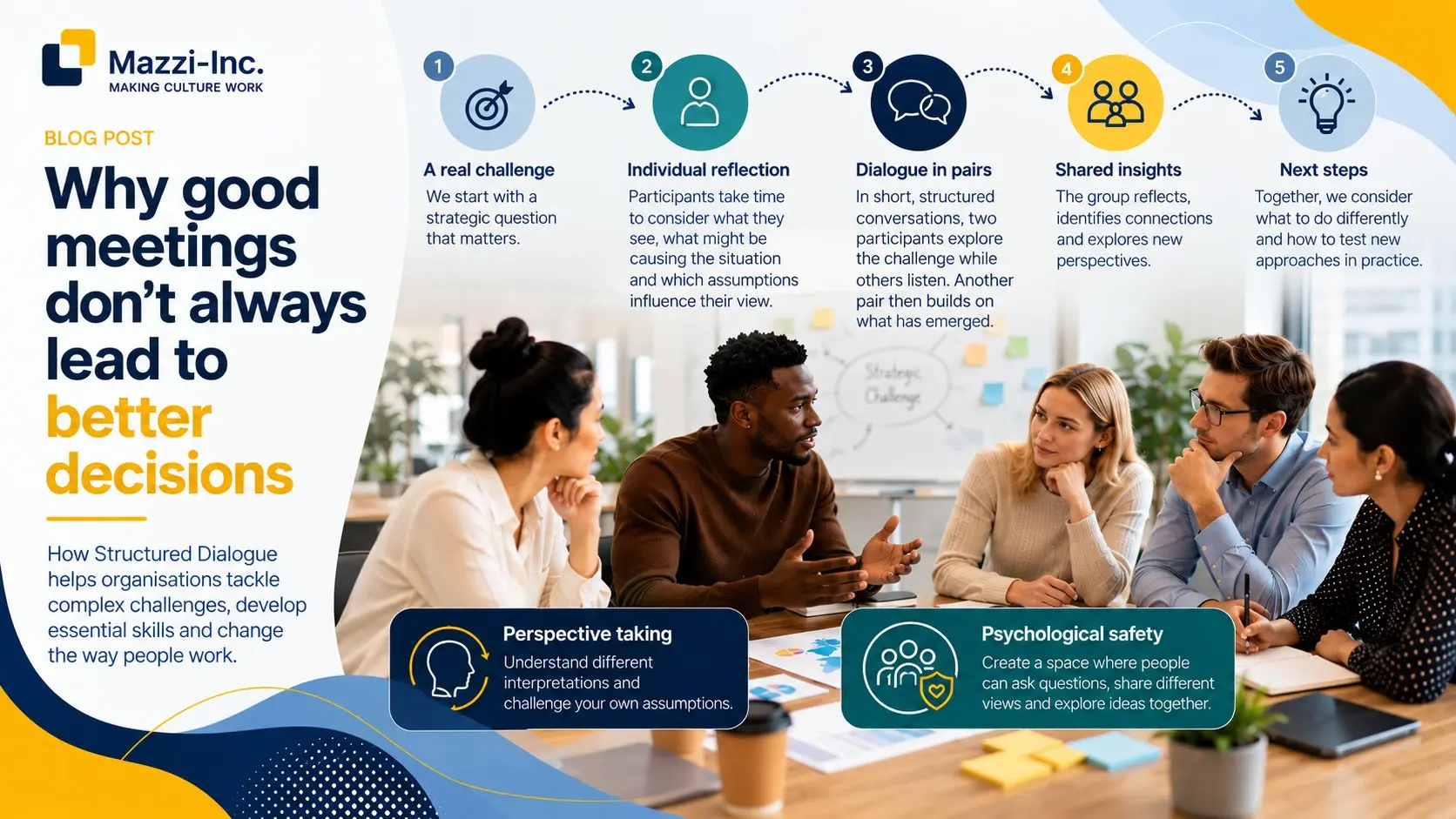
A Jazz Session begins with a real challenge that matters to the organisation.
Imagine a management team exploring this question:
Why do important decisions still move up the hierarchy when we want teams to take greater ownership?
Participants first reflect individually on what they observe, what may be causing the situation and which assumptions influence their interpretation.
The group then enters a series of short, structured conversations.
In Hugander's approach, two participants explore the challenge together while the others listen. After a few minutes, another pair continues, building on what has already been shared.
The listeners aren't preparing counterarguments. Their task is to understand, notice connections and consider perspectives they may have overlooked. Reflection moments help the group identify emerging insights.
Gradually, a more complex picture develops.
Perhaps managers aren't simply reluctant to delegate. Team members may have learned that taking decisions independently carries risks. Previous experiences may have taught them that important decisions require approval, even when formal responsibilities suggest otherwise.
What looked like a lack of ownership may reflect expectations that have developed over time.
Structured Dialogue doesn't automatically provide the answer. But it helps people understand the challenge more fully, creating a stronger basis for deciding what to do differently.
The skills that make different perspectives valuable
Bringing people with different perspectives together doesn't automatically lead to better decisions.
A direct question may be interpreted as criticism. Silence may be mistaken for agreement. People may hesitate to challenge assumptions when they're uncertain how others will respond.
This is why perspective taking and psychological safety matter.
Perspective taking helps people recognise that their interpretation isn't the only possible one. Psychological safety makes it easier to ask questions, acknowledge uncertainty and express concerns without fear of negative interpersonal consequences.
At Mazzi-Inc., we connect these capabilities to our broader understanding of intercultural competence.
Intercultural differences aren't limited to national cultures. People may interpret the same situation differently because of their professional backgrounds, responsibilities, experiences or expectations.
Working constructively with these differences requires curiosity, self-awareness, listening and the ability to question familiar assumptions.
Structured Dialogue offers an opportunity to practise these capabilities while addressing challenges people genuinely want to solve.
Change needs skills. Skills need change.
This principle is central to our approach at Mazzi-Inc.
If an organisation wants people to collaborate differently, make better decisions or take greater ownership, it cannot simply ask them to change their behaviour. People need the capabilities to understand different perspectives, recognise existing patterns and explore alternatives.
Change needs skills.
But learning those skills in a training room isn't enough.
People need opportunities to apply them, experience the results and reflect on what works. When a different way of listening or collaborating helps them make progress, their assumptions about effective behaviour can begin to change.
Skills need change.
This connection also helps organisations escape the capability trap. Applying skills directly to meaningful challenges makes their value more visible and gives people a reason to keep practising.
The result isn't simply a better conversation. It's an opportunity to develop new ways of working through experience.
From better conversations to lasting change
A Jazz Session may reveal why an existing pattern persists and help people identify alternatives. But understanding a problem is only the beginning.
Returning to our example, a team might experiment with clearer decision boundaries, different escalation agreements or new ways for managers to respond when employees take initiative.
These changes can then be tested in everyday work. Through repeated application, reflection and learning, people discover which approaches better support the organisation's ambitions.
Lasting change also depends on the work environment. Existing processes, responsibilities and expectations can reinforce new behaviour or pull people back into familiar patterns.
That is why Structured Dialogue is most valuable as part of a broader approach to cultural change.
How Mazzi-Inc. builds on Hugander's work
The Jazz Sessions developed by Per Hugander are an important foundation for our work. His skills-based approach, described in MIT Sloan Management Review, demonstrates the value of developing interpersonal capabilities while addressing meaningful business challenges.
At Mazzi-Inc., we have further developed and integrated these ideas into our Skills-Based Approach to Cultural Change.
We connect intercultural competence development to an organisation's strategic direction and the capabilities it needs to strengthen.
Structured Dialogue helps people explore existing patterns, understand different interpretations and develop possible ways forward. We also use adapted Jazz Sessions to investigate how desired behaviours can be supported through changes in routines, processes and expectations.
New approaches are tested in real work situations, with attention to what helps effective patterns become established.
In this way, people strengthen their own capabilities while improving how the organisation collaborates, leads and makes decisions.
Our aim is to help organisations develop the ability to keep learning and adapting without remaining dependent on external facilitators.
Better decisions begin with better understanding
Not every meeting needs to be a Jazz Session. Sometimes a decision simply needs to be made.
But when familiar problems keep returning, perspectives seem difficult to reconcile or proposed solutions fail to produce lasting results, another action plan may not be the best starting point.
A different kind of conversation can help.
One in which people listen to understand rather than respond. One in which assumptions can be questioned without immediately triggering defensiveness. And one in which exploring the challenge comes before deciding how to solve it.
Because changing the way people work often begins with changing the way they explore problems together.
Explore our approach
Discover how Mazzi-Inc. combines intercultural competence development, Structured Dialogue and practical experimentation to help organisations align everyday ways of working with their strategic ambitions.
Learn more about Strategy-Culture Alignment →
Further reading
- Vera Ludwig, Elizabeth Johnson, Michael Platt and Per Hugander (2023). How Jazz Can Unlock Your Team's Next Breakthrough. Knowledge at Wharton.
- Per Hugander (2023). Take a Skills-Based Approach to Culture Change. MIT Sloan Management Review.
- Per Hugander and Amy Edmondson (2024). Skills Training Links Psychological Safety to Revenue Growth. MIT Sloan Management Review.