Why these terms matter
Multicultural, cross-cultural, intercultural—these terms are often used interchangeably. At first glance, they may seem similar, but in practice, the differences are significant. Not only in how we describe collaboration, but more importantly in how we shape it. Because ultimately, it’s not just about who is in your team. The real question is: how do people actually work together? That’s where the distinction begins.
Multicultural teams: together, but not yet connected
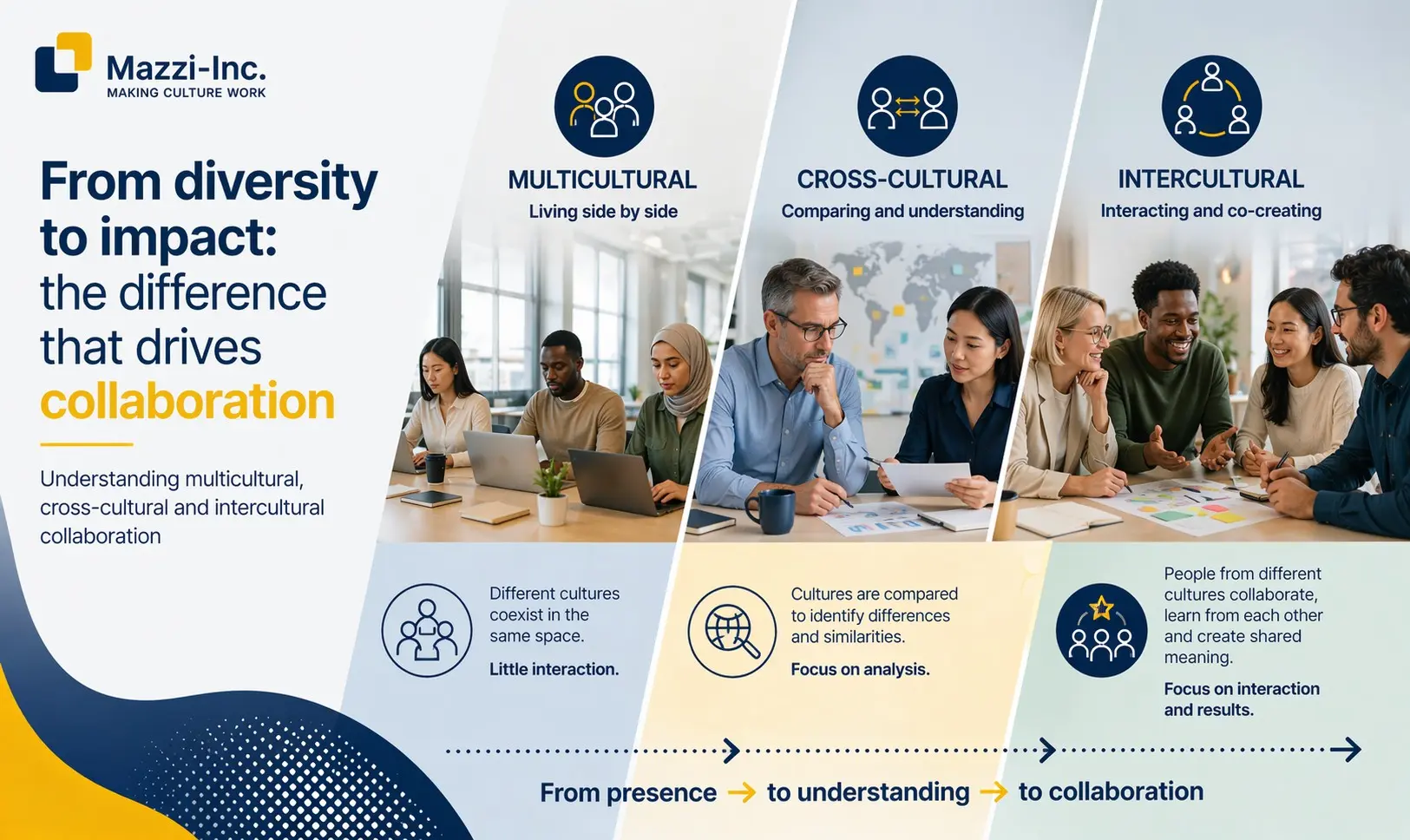
Many organizations today are multicultural. People from different cultural backgrounds work side by side within the same team, department, or organization. But diversity alone says very little about the quality of collaboration. In reality, cultures often coexist without truly connecting. Perspectives remain separate, and interaction is limited. People collaborate, but largely from within their own cultural frame of reference. This stage is primarily about presence—not interaction. Multicultural, therefore, is an important starting point—but it is not the destination.
Cross-cultural work: understanding through comparison
The next step organizations often take is cross-cultural work. Here, the focus shifts from presence to understanding. Teams begin to explore differences. They compare cultures, analyse communication styles, and seek to understand how leadership or decision-making may vary across contexts. This can provide valuable insights. It helps people interpret behavior and make sense of misunderstandings. At the same time, this approach often remains analytical. It is about observing and comparing. You learn to recognise differences, but that does not automatically translate into working effectively across them. And that is exactly where the limitation lies.
Intercultural collaboration: where real impact happens
Intercultural collaboration moves beyond both presence and analysis. It is no longer about who is in the team or how cultures differ—it is about what happens between people. At its core, it is about interaction. This means actively working across cultural boundaries, adapting behavior when needed, and developing new ways of collaborating together. Shared understanding emerges—not because differences disappear, but because they are actively used. The focus here is on mutual exchange and joint development. And that is where real collaboration begins.
Why intercultural competencies make the difference
In many organisations, teams remain somewhere between multicultural and cross-cultural. They are diverse, and they often understand differences—but that understanding does not always translate into effective collaboration. The difference lies in behavior. Teams that collaborate interculturally go beyond awareness. They adapt, align, and co-create new ways of working. This requires specific competencies, such as cultural awareness, communication flexibility, and the ability to integrate multiple perspectives. It also requires the ability to deal with ambiguity and uncertainty—something that is inherent in working across cultures. Without these competencies, diversity remains largely untapped potential.
From insight to impact
For organisations, this means that diversity alone is not enough. A multicultural team without intercultural capabilities will only realise part of its potential. This becomes visible in everyday practice: misunderstandings persist, collaboration feels less effective, and opportunities for synergy are missed. Real value emerges when organisations consciously invest in how people work together. Not just in structures or processes, but in interaction, behavior, and shared meaning. That is where the shift from presence to impact takes place.
How do you move toward intercultural collaboration?
Moving from multicultural to intercultural collaboration does not require a complete overhaul—but it does require intention. It starts with making differences discussable, not as a problem, but as a foundation for collaboration. From there, it is essential to move beyond analysis and translate insights into behavior. How do you adapt communication? How do you align expectations more effectively? Flexibility also plays a key role. There is no single “right” way of working. Effective teams develop their own shared approach, based on the people within them. Ultimately, it is about creating shared norms—a way of working that works for everyone.
Reflection: where does your team stand?
Take a moment to reflect on your own team. Are you mainly working alongside each other, or truly with each other? To what extent do team members adapt to one another? And how consciously do you invest in collaboration? The answers to these questions often reveal more than the team’s diversity itself.
From diversity to real collaboration
Diversity creates opportunity. But without interaction, that opportunity often remains unrealised. Intercultural collaboration requires active engagement, mutual understanding, and a willingness to grow together. It is not something that happens automatically—it is something that needs to be developed intentionally. And that is where the real strength of international teams emerges.
Strengthening intercultural collaboration with Mazzi-Inc.
At Mazzi-Inc., we support organisations in making this shift. Not just by helping them understand differences, but by showing how to work with them in practice. We help teams and leaders develop intercultural competencies, adapt behavior, and turn differences into strengths. Always practical, relevant, and directly applicable.
Ready to strengthen your intercultural collaboration?
Want to unlock more value from the diversity in your team? We’d be happy to explore this with you. Get in touch and discover how we help organizations move from multicultural to truly intercultural collaboration.
Curious about our Intercultural Collaboration Training Programmes?