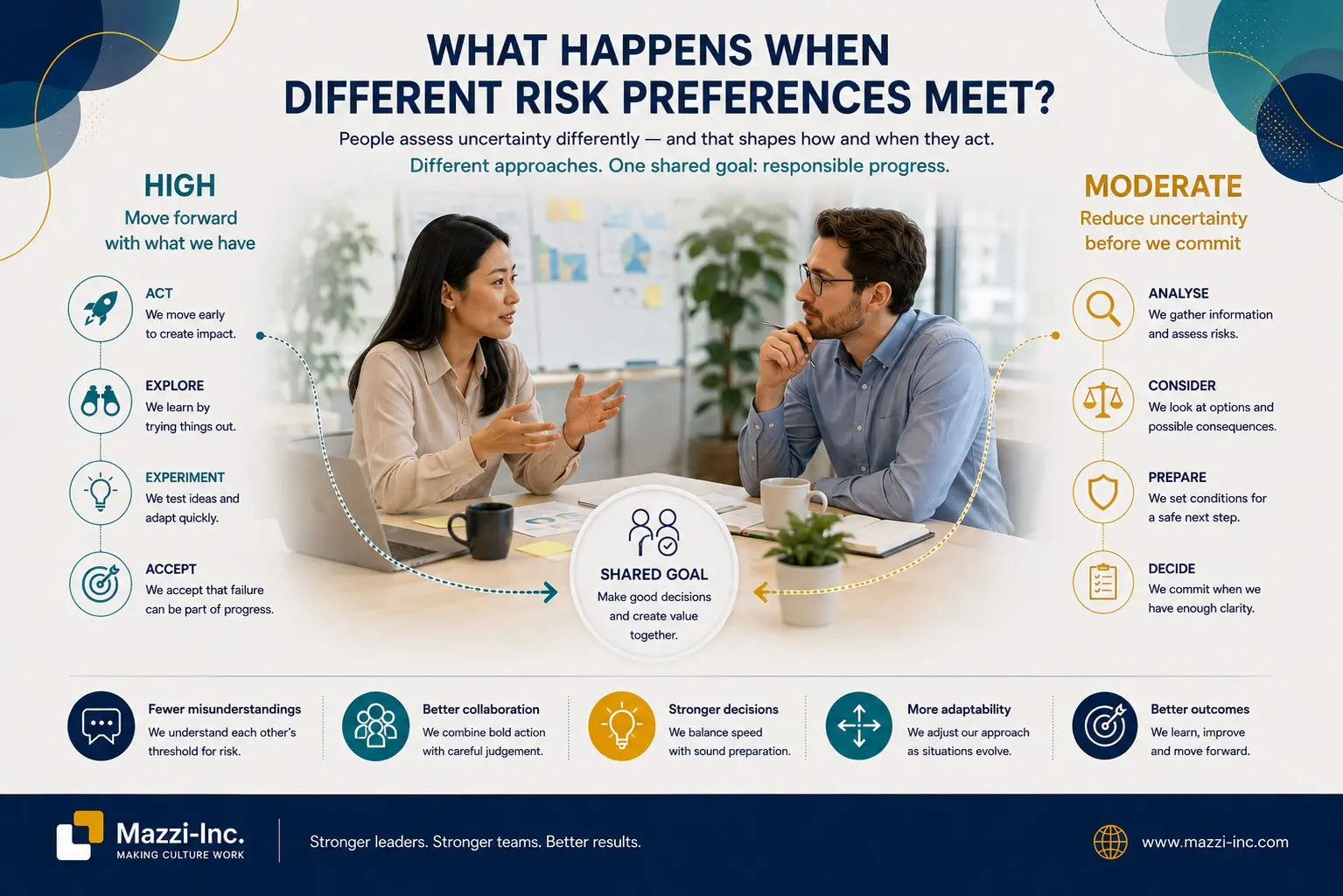
Imagine that your team has identified a promising new approach. It could improve the way you work, save time or open up a new opportunity. You have enough information to see the potential, but you do not yet know exactly what will happen if you go ahead.
One colleague is ready to try it. There is always some uncertainty when something is new, and the only way to find out whether it works may be to start experimenting.
Another colleague is less comfortable. Before committing, they want to understand the possible consequences, gather more information and perhaps test the approach on a smaller scale.
Who is being more responsible? There is no simple answer. Both people may be trying to make a good decision. They simply have different ideas about how much uncertainty is acceptable before action is justified.
How much uncertainty can we accept?
Risk is part of everyday work. People make decisions with incomplete information, try new approaches and sometimes have to act before all the possible consequences are known. What differs is how comfortable people are with uncertainty and how much risk they consider acceptable when making decisions and taking action.
Some people are comfortable moving forward despite uncertainty. They may see calculated risk as a necessary part of innovation, learning and progress. Trying something new can be valuable precisely because the outcome is not yet known.
Others prefer to reduce uncertainty before committing to a course of action. Gathering information, considering possible consequences and limiting exposure to risk can be seen as important parts of working responsibly.
Neither approach is inherently better. The interesting question is what people believe needs to be known, tested or considered before it is reasonable to move forward.
When does taking a risk feel responsible?
Consider a team that wants to introduce a new way of working.
One colleague may argue that the team already knows enough to start. They may see a small amount of uncertainty as unavoidable and believe that learning from experience is more useful than spending additional time trying to predict every possible outcome.
Another colleague may want to understand the risks first. What could go wrong? What would the consequences be? Can the approach be tested on a smaller scale? What alternatives are available if the experiment does not work?
This also raises the question of what people consider sufficient justification for a decision. What information or arguments do they find convincing? We explore this in our blog ‘When Is an Argument Convincing?’.
The difference is not necessarily about how much either person values innovation. They may simply have different ideas about what responsible action looks like when the outcome is uncertain.
This can also become visible when a decision has to be made quickly. One person may feel comfortable acting on the information that is available, while another may prefer to delay the decision until more information can be gathered. What one person experiences as decisive action may therefore feel premature to the other.
What happens when something new is introduced?
Differences in risk-taking can become particularly visible when people experiment.
One colleague may see experimentation as a valuable way to learn. If an approach does not work, that is part of the process, and the experience provides information for the next attempt.
Another may prefer to reduce the potential consequences before experimenting. They may suggest starting with a smaller group, establishing clearer conditions or testing the approach before introducing it more widely.
Rules and procedures can also influence how much room people believe there is for experimentation. People may have different views on when established ways of working should be followed and when making an exception is justified. We explore this in our blog ‘When Is Following a Rule the Fair Thing to Do?’.
Neither necessarily wants less innovation. They may simply have different ideas about how much exposure to uncertainty is appropriate while learning.
The same difference can appear when an organisation is going through change. Some people may be comfortable adapting as circumstances develop, while others want a clearer picture of the direction, possible consequences and available alternatives before changing course.
What happens when things go wrong?
Attitudes towards risk can become particularly visible after something has not worked as expected.
One person may see failure as an expected part of experimentation and immediately focus on what can be learned from it. Another may first want to understand what caused the failure and what could be done to prevent a similar situation in the future.
Again, neither response necessarily tells us how much someone values learning or improvement.
The difference may lie in what they believe the failure means. One person may see it primarily as information that helps the organisation learn. Another may see it as a signal that the decision-making process or risk assessment needs closer examination.
Understanding that difference can be particularly important in teams where people need to learn from mistakes without losing sight of responsibility and consequences.
When preferences meet
Different expectations about risk can easily lead to personal interpretations of behaviour.
Someone who is comfortable taking risks may experience a more cautious colleague as hesitant, overly careful or unwilling to move forward. The more cautious colleague may experience the same person as impulsive, insufficiently thorough or too willing to accept unnecessary risk.
Both may be responding appropriately from their own perspective.
The difference lies partly in what they believe is required before action is justified. One person may see uncertainty as something that can be managed while moving forward. Another may see reducing uncertainty as a necessary condition for responsible action.
Once we recognise this, a useful conversation becomes possible. Instead of asking why someone is being too cautious or too reckless, we can ask what they are considering, what they see as being at stake and why they believe a particular level of risk is appropriate.
That shift can turn a disagreement about action into a conversation about assumptions.
From awareness to intercultural skill
Recognising differences in attitudes towards risk is a first step. The real intercultural skill develops when we can use that awareness in everyday work: when making decisions, introducing new ideas, responding to change, experimenting or assessing possible consequences.
Explore these different preferences in more detail on our Cultural Profiler dimension page Risk Taking.
The goal is not to become more willing or less willing to take risks. It is to recognise what the situation requires, understand how others may assess uncertainty differently and choose how to respond.
Sometimes moving forward despite uncertainty is exactly what a situation requires. At other times, reducing uncertainty before acting may prevent unnecessary consequences. Often the most useful approach is not choosing one side, but finding a way to move forward while making the remaining uncertainty visible and manageable.
The intercultural skill lies in being able to recognise what level of uncertainty the situation can reasonably accommodate — and what others need in order to work with it.
What does this mean for your team?
The next time a decision seems to divide the team between “let's just try it” and “let's first find out more”, it may be worth looking beyond the decision itself.
Perhaps people are not disagreeing about the goal. They may simply have different ideas about what needs to happen before the goal can responsibly be pursued.
When does a decision feel sufficiently safe for people in your team to move forward?
And what happens when colleagues have different answers to that question?
These questions can open a valuable conversation about uncertainty, responsibility, innovation and decision-making.
The Mazzi-Inc. Cultural Profiler makes cultural preferences visible that may influence how people approach uncertainty, make decisions, respond to change and assess risk at work.
Want to explore how different approaches to risk influence your team?
Discover the Mazzi-Inc. Cultural Profiler