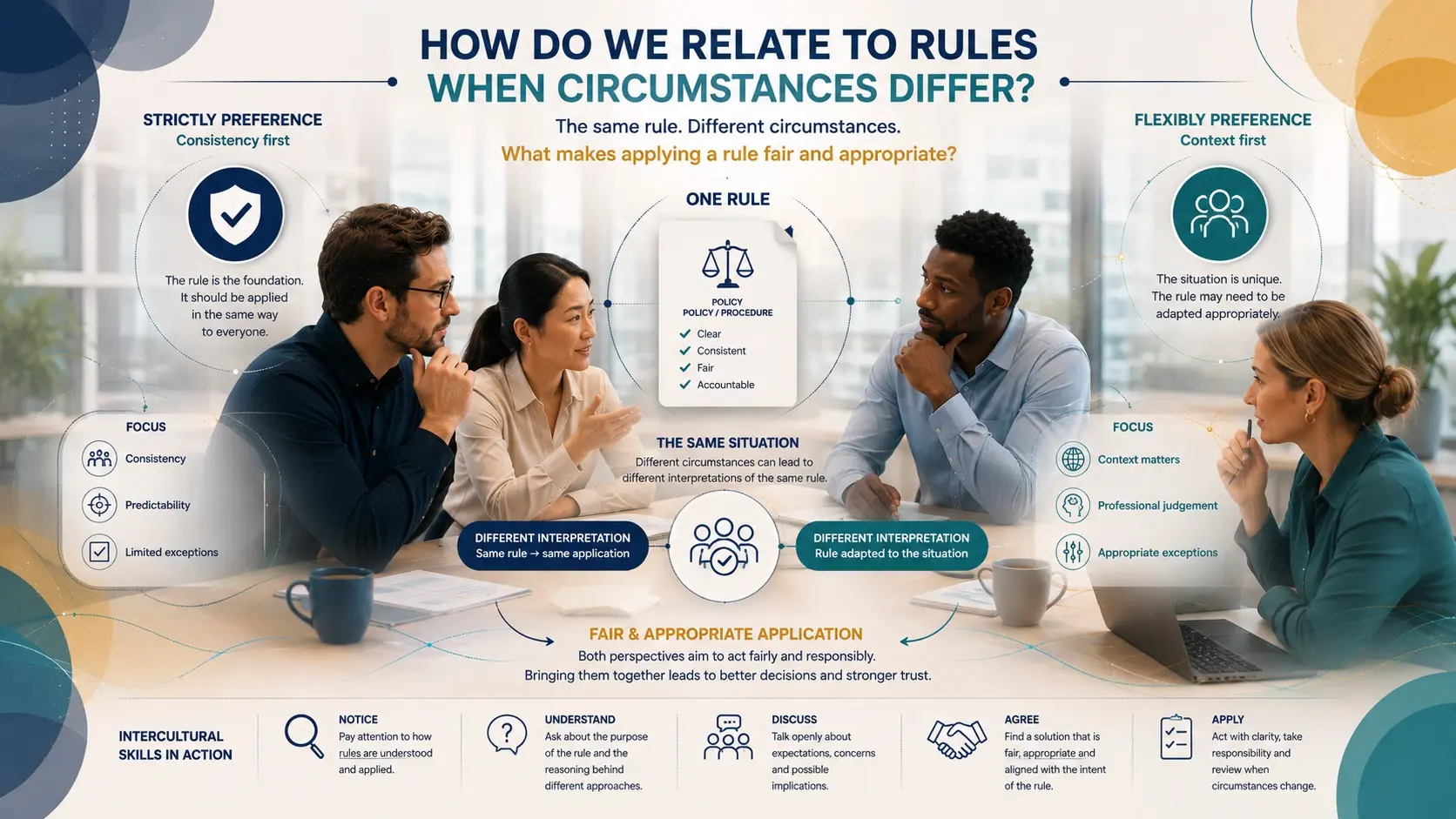
Imagine that a colleague asks you to make an exception to an established procedure. The situation seems reasonable, and following the procedure exactly as written would create an outcome that does not quite make sense in this particular case. You could follow the procedure because it exists for a reason and because other people are expected to follow it as well. Or you could look at the circumstances, decide that this situation is different and make an exception. Which response is fair?
For some people, the answer may seem straightforward. If a rule applies to everyone, applying it differently in one situation can feel unfair. For others, treating different circumstances in exactly the same way may itself feel unfair. They may believe that applying a rule appropriately sometimes means considering the situation in which it is being used.
Neither perspective necessarily reflects a different commitment to fairness. People may simply have different ideas about what rules are meant to achieve and what a fair application of a rule looks like when circumstances differ.
What are rules for?
Rules and procedures are part of everyday organisational life. They create structure, clarify expectations and help people coordinate their work. They also make decisions more predictable: when people know what is expected and how a procedure normally works, it becomes easier to understand how situations will be handled.
At the same time, the reality of work rarely fits perfectly into predefined procedures. Customers have different needs, unexpected situations arise and circumstances can change. A procedure that works well in one situation may not produce the same result in another.
This is where different expectations about rules become visible. Some people feel more comfortable when rules are applied consistently, because consistency provides clarity and helps ensure that people are treated according to the same standards. Others may see rules as an important framework while also allowing room for context and professional judgement. When circumstances are genuinely different, they may feel that an appropriate response requires some flexibility.
The difference, then, is not simply about whether someone follows rules. It is about what people believe a rule should provide and what they think should happen when reality does not fit the rule perfectly.
When consistency feels fair
Consider an organisation with a clear approval process. A colleague asks for an exception because their situation is unusual. The request seems reasonable, but approving it would mean treating this case differently from others.
Someone who prefers a more consistent application of rules may be concerned about what that means for everyone else. If an exception is made here, should the same exception be available to others? From this perspective, keeping the rule consistent protects predictability and helps ensure that people are treated according to the same standards.
Another colleague may look at the same situation differently. They may agree that the rule is important, but believe that the circumstances make this case sufficiently different to justify another response. For them, treating the situation exactly like all others could mean overlooking something that matters.
Both may believe they are acting fairly. The difference lies in whether fairness is primarily associated with consistent treatment or with taking relevant differences in circumstances into account.
The same tension can arise when applying procedures. One person may expect an established process to be followed step by step, while another may look for a way to adapt it when following it literally could create an undesirable outcome.
When a rule meets a real situation
The difference becomes particularly visible when a rule encounters a situation that was not fully anticipated when the rule was created.
Imagine a customer whose circumstances do not fit neatly within an existing policy. Applying the policy as written may provide a clear and consistent response, and it may be relatively easy to explain why that response was chosen. Looking at the individual circumstances, however, may lead to a different conclusion about what would be appropriate in this particular case.
This is where one person's consistency can become another person's inflexibility. At the same time, what feels like sensible professional judgement to one person can look like inconsistency to someone who expects the same policy to apply in the same way to everyone.
These differences are not limited to formal policies. They can also appear in approval processes, compliance requirements and everyday team agreements. The important question is therefore not simply whether a rule is being followed, but what people believe makes its application appropriate and fair.
When preferences meet
Because people can attach different meanings to consistency and flexibility, their behaviour can easily be interpreted in personal terms. Someone who prefers rules to be applied consistently may experience a colleague who makes exceptions as unpredictable or too willing to set established procedures aside. The colleague who allows more room for context may see the same behaviour as unnecessarily rigid, particularly if following the rule seems to get in the way of achieving its intended outcome.
Both may believe they are acting responsibly. The difference lies partly in how they understand the purpose of the rule and what they consider a fair way to apply it. One person may see consistency as an important protection against arbitrary decisions, while another may believe that fairness requires taking relevant differences into account.
Once we recognise this, it becomes easier to move beyond judging someone as either “too rigid” or “too flexible”. A more useful question is what the other person believes the rule is intended to achieve and why they consider their response appropriate. That does not mean we have to agree with their interpretation. It simply gives us a better basis for understanding the reasoning behind it.
From awareness to intercultural skill
Recognising these differences is a first step. The real intercultural skill develops when we can use that awareness in everyday situations: when applying procedures, considering exceptions, dealing with customers or colleagues, or deciding how much room a particular situation allows for interpretation.
The goal is not to become more strict or more flexible. It is to recognise what the situation requires, understand that others may interpret the role of rules differently and consciously choose how to respond.
Sometimes that may mean following a procedure exactly because consistency and predictability are important in that situation. At other times, it may mean considering whether the circumstances justify a different application. In either case, being able to explain the reasoning behind the decision can be just as important as the decision itself.
What does this mean for your team?
The next time someone suggests making an exception to a rule, it can be useful to notice your own first reaction. Perhaps your instinct is to think that if an exception is made for one person, the same should be possible for everyone. Or perhaps you immediately see the circumstances as sufficiently different to justify another approach.
Neither reaction is necessarily right or wrong. It may simply reveal something about what you consider important when rules meet real-world situations: consistency, predictability, context, proportionality or the intended outcome of the rule.
What happens in your team when a rule meets a situation it was not designed for? How do you decide whether consistency or context should carry more weight, and how do you make sure that people with different preferences can understand the reasoning behind the decision?
These questions can open a valuable conversation about how your team understands rules, fairness and professional judgement.
The Mazzi-Inc. Cultural Profiler makes cultural preferences visible that may influence how people interpret rules, procedures, fairness and professional judgement. Want to explore how your team approaches rules and exceptions?
Discover the Mazzi-Inc. Cultural Profiler