Imagine that you have an important meeting at ten o'clock. You leave in good time because you have every intention of arriving on time. On the way, however, you meet a colleague or business contact you know well. They stop to talk, and the conversation becomes more meaningful than a quick greeting. You know you will probably arrive a few minutes late if you stay, but you also feel that this relationship deserves your attention.
What do you do?
For some people, the answer is obvious: you continue on your way. You have an appointment, and the appointment should be respected. In the Netherlands, the expression “afspraak is afspraak” captures this expectation particularly well. Once something has been agreed, the agreement is expected to be honoured.
In other contexts, the same situation may be understood differently. Taking a few minutes to maintain an important relationship may be considered more important than arriving at exactly the agreed time. A small delay can be understood because the relationship itself carries value.
Neither person necessarily intends to be inconsiderate. They may simply have different assumptions about how time should be organised and what deserves priority when expectations compete.
Is time something we organise — or something we respond to?
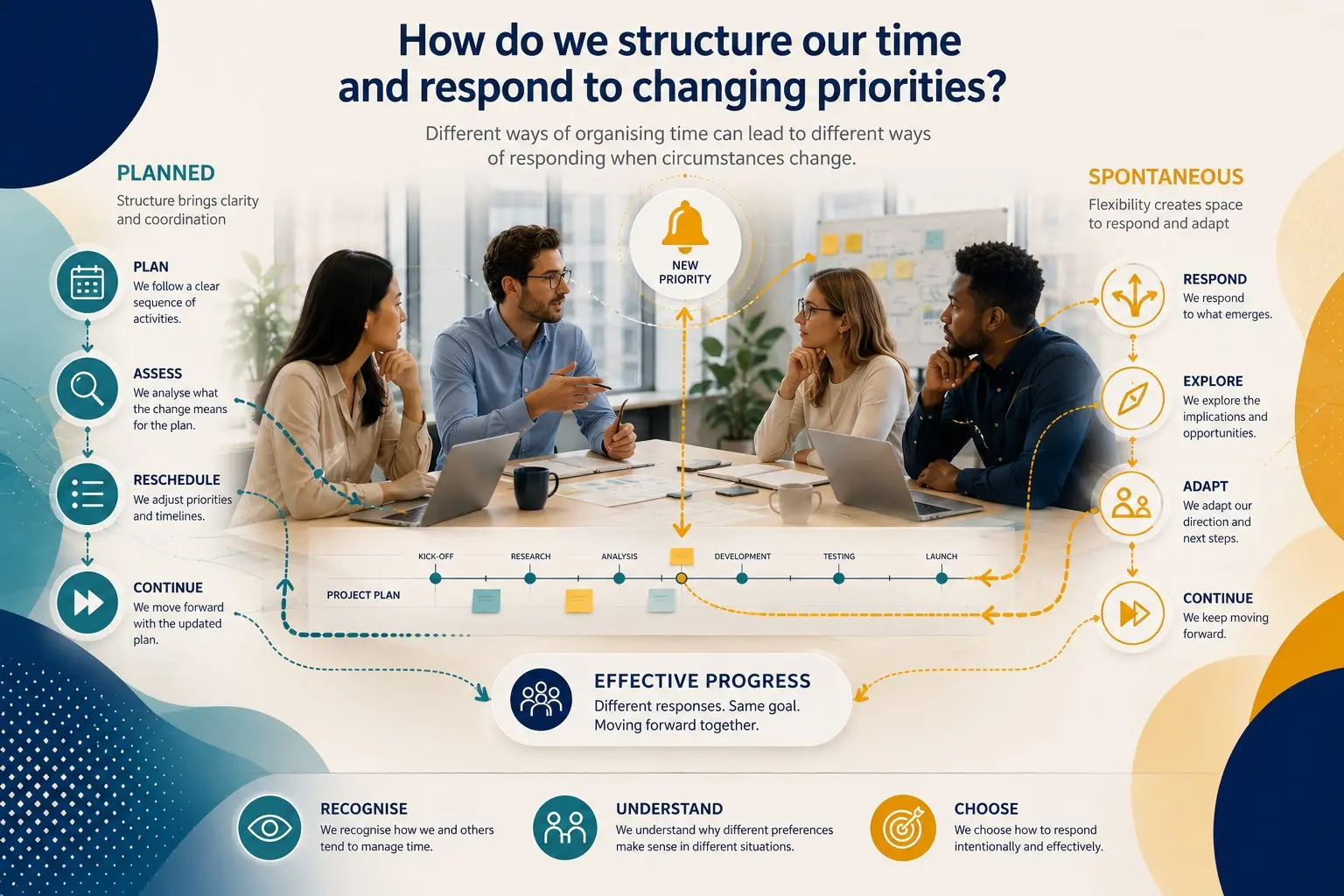
Time is a constant part of working life. We plan activities, set priorities, work towards deadlines and adjust our schedules when circumstances change. What differs is how much people prefer to structure their time in advance, how firmly they see plans and commitments and how comfortable they are with changing their schedules as work develops.
Some people feel comfortable when their work is organised around clear plans, schedules and timelines. Knowing what needs to happen, when it needs to happen and how different activities fit together can create focus and make it easier to coordinate with others. A plan provides a structure within which work can progress.
Others prefer to leave more room in their schedules. They may be comfortable adjusting their time when new information emerges, priorities change or an unexpected opportunity presents itself. Relationships can also influence how they use their time, particularly when responding to the needs of people around them is considered an important part of working effectively.
Neither approach is inherently better. The interesting question is what people expect from plans and commitments, and how they respond when reality does not follow the plan.
What does a deadline mean?
The difference becomes particularly visible when people work towards deadlines.
One colleague may experience an agreed deadline as a commitment that should guide the work from the moment it is established. The date provides a clear point towards which activities can be organised, and changing it may have consequences for other people who have planned around it.
Another colleague may see the same deadline more as a useful target. It provides direction, but circumstances may change, and adjusting the date can be perfectly reasonable if that helps the work respond to new information or priorities.
Neither person necessarily takes deadlines more or less seriously. They may simply have different expectations about how firmly a plan should guide what happens next.
The same difference can appear when priorities change. One person may first want to understand what the new priority means for the existing plan and what needs to be rescheduled. Another may be comfortable changing direction immediately and deciding along the way what should happen next.
What looks like careful planning to one person may therefore look like unnecessary rigidity to another. Conversely, what feels like useful flexibility to one person may feel like a lack of structure to someone else.
When does flexibility become important?
Unexpected opportunities can make these differences even more visible.
Imagine that an interesting opportunity appears in the middle of a busy project. Someone with a more planned approach may first consider whether the opportunity fits with existing priorities and commitments. There is already work to be done, and changing direction may have consequences elsewhere.
Someone with a more spontaneous approach may be more inclined to explore the opportunity immediately. The value of responding while the opportunity is available may outweigh the need to protect the existing plan. The question of how the opportunity fits into the broader work can be addressed later.
Again, this does not necessarily reflect different levels of commitment. The two people may simply have different ideas about whether effective progress comes primarily from following a plan or from responding well to what emerges.
When tasks and relationships compete
This becomes especially interesting when time needs to be divided between tasks and relationships.
A colleague may be on the way to an important meeting when they encounter someone they know. One person may think, “I have an appointment, so I need to continue.” Another may think, “This relationship is important, so I should take a moment to connect.”
From the first perspective, continuing on time demonstrates reliability and respect for the people waiting at the meeting. From the second, taking the time to maintain the relationship may be an equally important expression of respect and responsibility.
This is one reason why differences around time can be so easily misunderstood. We often experience our own approach not as a preference, but as common sense.
If being on time means keeping a commitment, arriving late can feel disrespectful. If responding to an important relationship is part of fulfilling one's responsibilities, leaving the conversation simply because of the clock can feel equally inappropriate.
The behaviour is visible. The assumptions behind it are not.
How much room we make for personal connections at work also relates to our expectations about professional relationships. We explore this further in our blog ‘When Does a Professional Relationship Become a Good Relationship?’.
When preferences meet
Different expectations about time can therefore lead to surprisingly strong judgements.
Someone who strongly prefers planning may experience a more spontaneous colleague as unstructured, unpredictable or insufficiently committed to agreed timelines. The spontaneous colleague may experience the same person as rigid, overly focused on schedules or unwilling to adapt when circumstances change.
Both may be responding appropriately from their own perspective.
The difference lies partly in what they believe creates effective progress and what deserves priority when different expectations compete. For one person, clear plans and punctuality create focus, reliability and mutual respect. For another, flexibility and responsiveness make it possible to deal effectively with reality as it unfolds or to give attention to important relationships.
Once we recognise this, the conversation can change. Instead of asking why someone cannot simply follow the plan, or why they cannot simply be more flexible, we can ask what they are trying to achieve and what they believe is important in that moment.
That does not mean that every difference in behaviour should simply be accepted. Teams still need shared expectations about deadlines, meetings and commitments. But those expectations become easier to negotiate when we recognise that people may not attach the same meaning to them in the first place.
From awareness to intercultural skill
Recognising different approaches to time is a first step. The real intercultural skill develops when we can use that awareness in everyday work: when planning projects, setting deadlines, scheduling meetings, coordinating with colleagues, managing priorities or responding to unexpected changes.
The goal is not to become more planned or more spontaneous. It is to recognise what the situation requires, understand how others may approach time differently and choose how to respond.
Explore these preferences in more detail on our Cultural Profiler dimension page Time Management.
Sometimes a clear plan provides the structure a team needs. At other times, flexibility makes it possible to respond effectively to changing circumstances or give attention to an important relationship. Effective intercultural collaboration means being able to recognise the difference and adapt without automatically judging the other approach.
This is also where the familiar distinction between monochronic and polychronic time orientation can be useful. A more monochronic approach tends to organise time as a sequence of activities, with greater emphasis on schedules, deadlines and completing one activity before moving to another. A more polychronic approach allows several activities to happen alongside one another and may give greater room for schedules to change when circumstances or relationships require attention.
These concepts can help us recognise broader patterns, but they are not labels. People adapt their approach depending on the situation, the organisation, their role and the nature of the work.
What does this mean for your team?
The next time someone arrives late, changes a deadline or takes time away from a planned task to respond to an unexpected situation, it may be worth pausing before interpreting the behaviour.
What does this person believe is important right now?
And perhaps an even more useful question is: what do people in our team expect from plans, deadlines and commitments — and what happens when those expectations compete with changing circumstances or relationships?
These questions can open a valuable conversation about time, priorities and the assumptions that sit behind everyday ways of working.
The Mazzi-Inc. Cultural Profiler makes cultural preferences visible that may influence how people structure their time, plan their work, respond to deadlines, approach punctuality and deal with changing priorities.
Want to explore how different approaches to time influence your team?
Discover the Mazzi-Inc. Cultural Profiler