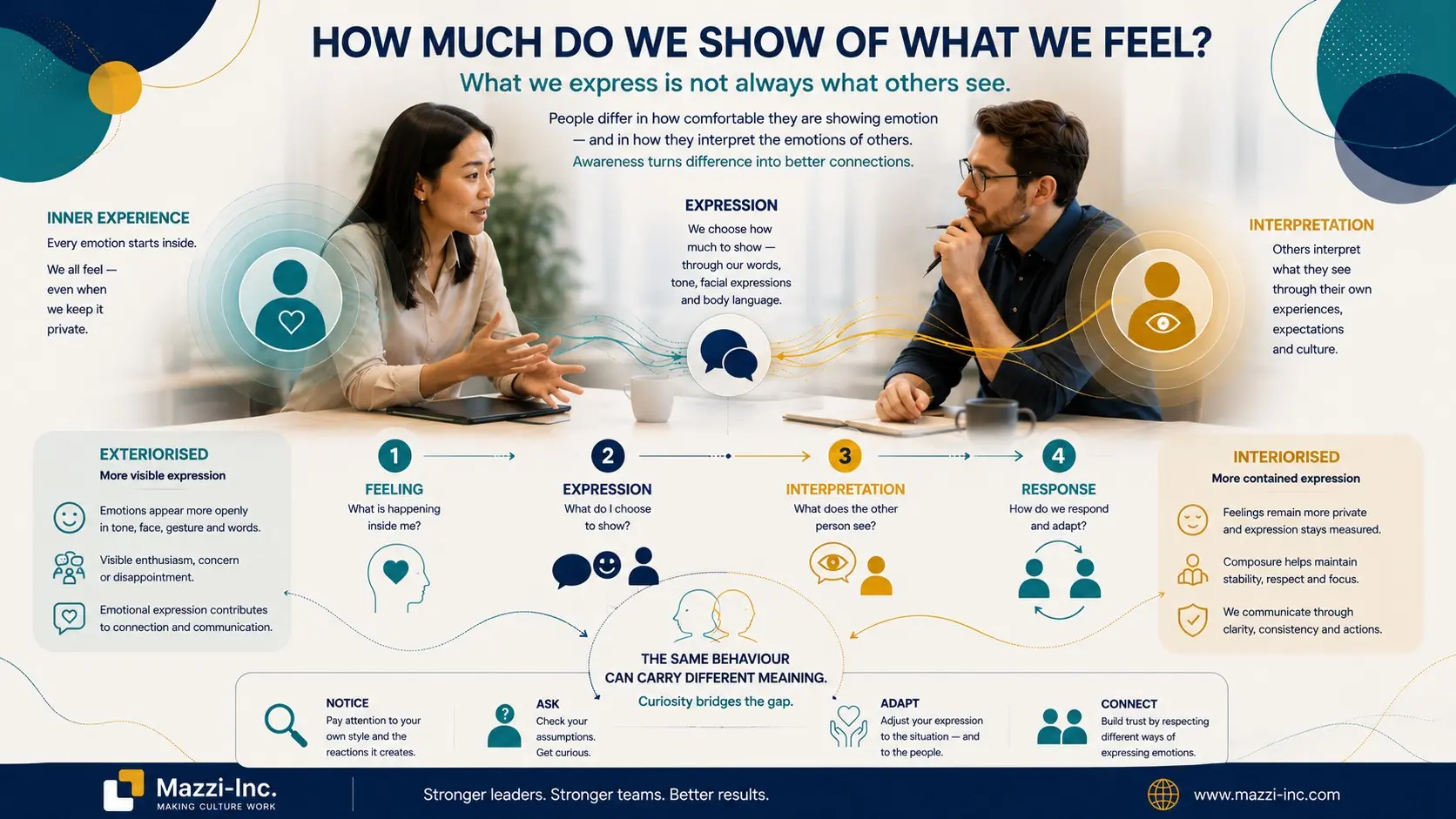
Imagine two colleagues sitting in a meeting discussing a difficult problem.
One of them reacts visibly. Their voice becomes more animated, they express frustration about what has happened and they make it clear that they care deeply about finding a solution.
The other remains calm. Their voice hardly changes, their expression stays composed and they focus on the facts of the situation.
Who seems more engaged? For one observer, the first person may appear genuinely involved. Their emotional response shows that the issue matters to them. The second person might seem distant or uninterested. For someone else, the interpretation could be exactly the opposite. The calm colleague may appear professional and in control, while the emotional response feels unnecessarily intense.
The interesting question is not which interpretation is correct. It is what we expect emotional expression to mean in a professional relationship.
How much should we show of what we feel?
Emotions are part of every working relationship. They influence how we respond to situations, connect with others and make sense of what is happening around us. What differs is not whether people have emotions, but how comfortable they are showing them and how they interpret emotional expression in others.
Some people are comfortable expressing enthusiasm, frustration, concern or disagreement openly. Their emotions may be visible in their words, tone of voice, facial expressions or gestures. For them, showing emotion can be a natural part of communication and relationship building.
Others may prefer to keep emotions more private, particularly in professional situations. Remaining calm and composed can be a way of showing respect, consideration or professionalism. Emotional control may help them maintain stability and keep attention on the issue at hand.
Neither approach is inherently better. The difference becomes interesting when people with different expectations about emotional expression work together.
When enthusiasm looks like too much
Consider a team celebrating the successful completion of an important project.
One colleague is visibly enthusiastic. They congratulate everyone, express their excitement and openly celebrate what the team has achieved. Another colleague smiles, says “Well done” and moves on to the next topic.
The first person may experience the second as strangely restrained. “Aren't they happy about what we achieved?” The second may wonder why so much emotion is needed. The achievement is clear. Why make such a display of it?
The same thing can happen when something goes wrong.
One person may immediately express concern or disappointment and want to talk about what happened. Another may prefer to take some time, process the situation and return to it once they have regained some perspective.
One approach can be interpreted as openness. The other can be interpreted as distance. But those interpretations may say as much about the observer as they do about the person being observed.
What does professionalism look like?
This becomes particularly interesting when emotions are connected to ideas about professionalism.
For some people, showing emotion can demonstrate authenticity and involvement. If someone is visibly enthusiastic about an idea or concerned about a problem, that may be interpreted as a sign that they genuinely care.
For others, professionalism may involve keeping emotions under control. Remaining composed, particularly under pressure, can signal respect for others and the ability to keep attention on the issue rather than the emotion surrounding it.
Neither interpretation necessarily tells the whole story. Someone who remains calm may care deeply about what is happening. Someone who expresses frustration openly may be highly professional and fully capable of managing the situation. The visible behaviour simply does not tell us everything that is happening underneath.
When preferences meet
This is where emotional expression can easily lead to misinterpretation.
Someone who is comfortable expressing emotions openly may experience a more restrained colleague as distant, uninterested or difficult to read.
The more reserved colleague may experience the same person as overly emotional, unpredictable or insufficiently professional.
Both may believe they are responding appropriately. The difference lies partly in what they think emotional expression communicates.
Our communication style also influences how we interpret other people's behaviour. It is not only the words someone chooses, but also their tone and the way something is said that can be understood differently. We explore this further in our blog ‘When “Being Clear” Means Different Things Across Cultures’.
One person may see visible emotion as evidence of authenticity, openness and involvement. Another may see emotional restraint as evidence of professionalism, respect and stability.
Once we recognise that, a different question becomes possible.
Instead of asking: “Why is this person so emotional?” or: “Why are they so cold?” we can ask: “What might emotional expression mean to this person?”
That question creates much more room for understanding.
The same emotion can be interpreted differently
Imagine a manager giving feedback to an employee.
The manager speaks with warmth and visible concern. They want the employee to know that the feedback matters and that they are invested in their development.
The employee, however, experiences the conversation as overly personal. They would have preferred a calm discussion focused on the content of the feedback.
The manager may think: “I'm showing that I care.” The employee may think: “Why is this becoming so emotional?”
Neither person necessarily has the wrong intention. They may simply have different expectations about how involvement and professionalism should be expressed.
The same can happen when people are under pressure, responding to change or discussing a sensitive issue. What one person experiences as openness may feel like a lack of control to another. What one person sees as composure may be interpreted by someone else as a lack of engagement.
From awareness to intercultural skill
Recognising these differences is a first step. The real intercultural skill develops when we can use that awareness in our everyday interactions.
Explore different preferences around emotional expression in more detail on our Cultural Profiler dimension page Expressing Emotions.
When someone reacts emotionally, we can pause before deciding what that reaction means. When someone remains composed, we can avoid assuming that they do not care. When giving feedback, we can consider how much emotional expression will help the other person engage with the message. And when a difficult conversation becomes more emotional than expected, we can ask ourselves whether the emotion itself is the problem — or whether we are simply interpreting it through our own expectations.
This also matters when people disagree. A lively debate may feel like a constructive way to reach a better solution for one person, while another may experience it primarily as tension. We explore these differences in our blog ‘When Does Disagreement Make a Team Stronger?’.
The goal is not to become more expressive or more restrained. It is to recognise what the situation requires, understand how others may interpret emotional expression differently and consciously choose how to respond.
That is a very different skill from simply learning to “control your emotions” or “show more emotion”. It is the ability to notice what is happening, question your first interpretation and choose a response that supports the relationship and the task.
What does this mean for your team?
The next time someone's emotional response surprises you, it may be worth pausing before deciding what it says about them.
Perhaps they are too emotional. Perhaps they really are distant. But perhaps you are simply seeing the same behaviour through a different set of expectations.
What does professionalism look like in your team when emotions become part of the interaction?
When does visible enthusiasm signal genuine involvement? When does emotional restraint create trust? And what happens when colleagues have very different answers to those questions?
These are not only questions about personality. They can also open a conversation about how people in your team understand professionalism, relationships and appropriate behaviour.
The Mazzi-Inc. Cultural Profiler makes cultural preferences visible that may influence how people communicate, collaborate, give feedback and respond to situations at work.
Want to explore how emotional expression may influence collaboration in your team?
Discover the Mazzi-Inc. Cultural Profiler