Why DEI is more than a buzzword
Diversity and Inclusion, D&I, DEI—these terms are everywhere. Many organisations invest in policies, initiatives, and programs aimed at building more inclusive workplaces. And yet, one question often remains. What do we actually mean by DEI? And more importantly, what does it mean in practice? Because as long as DEI remains abstract, its impact stays limited. Real change only happens when it becomes visible in how people interact, collaborate, and lead .
Three concepts, one connected approach
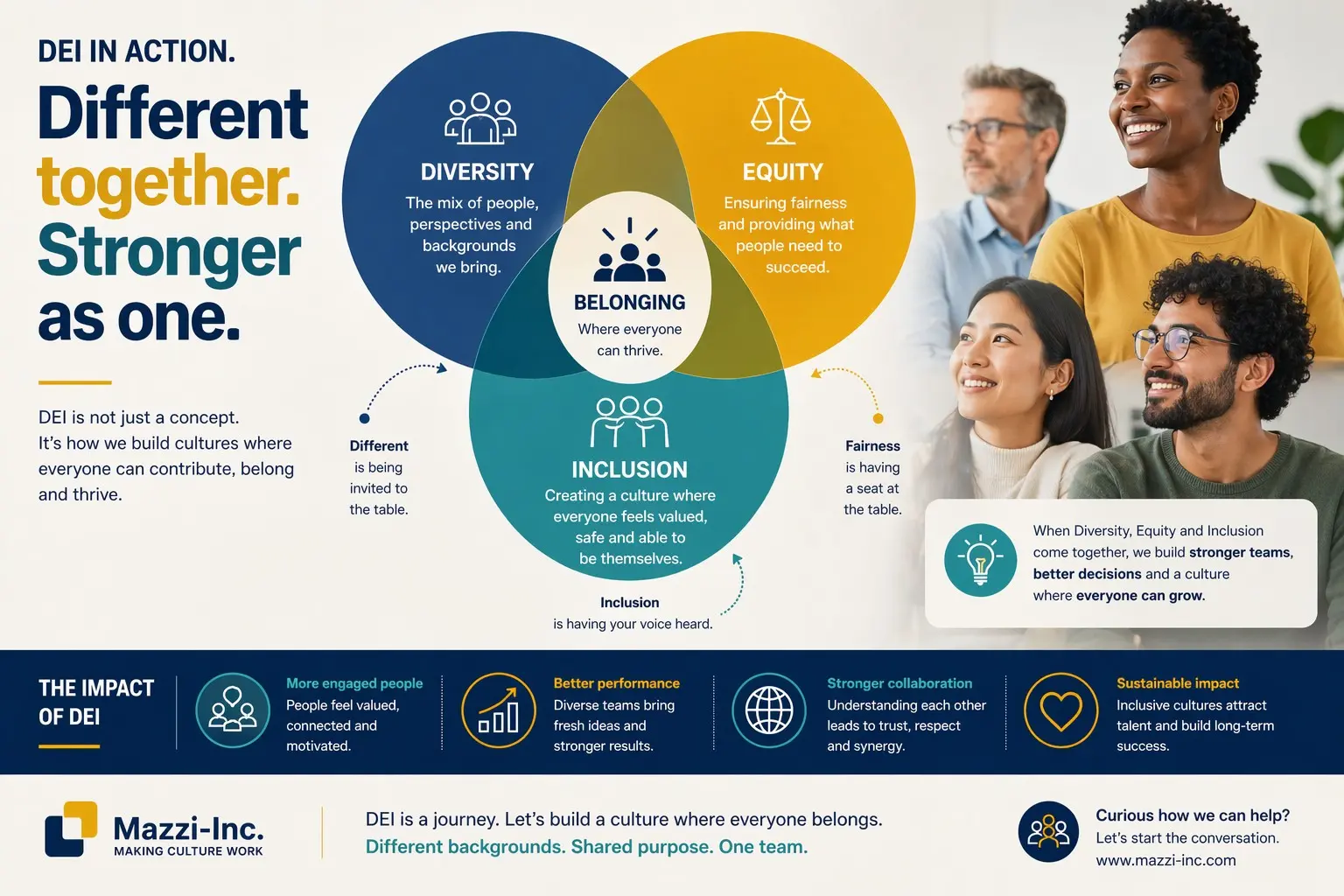
DEI stands for diversity, equity, and inclusion—terms that are closely linked, yet distinct in meaning. Diversity refers to the differences between people. Inclusion focuses on whether people feel able to participate and contribute. Equity connects the two: it ensures that people have what they need to succeed. It is this last element that is often underestimated. Because without equity, diversity may be present—but not effective.
Diversity: more than what we see
Diversity is often associated with visible characteristics such as nationality or background. In reality, it goes much further. It includes differences in perspective, communication style, experience, and ways of working. When organisations define diversity too narrowly, they overlook a significant part of its value. It is often the less visible differences that shape how teams function.
Equity: the foundation of real inclusion
One of the most common misunderstandings about DEI lies in the concept of equity. Equity does not mean treating everyone the same. It means providing people with what they need to succeed. This requires recognising differences and adapting systems, expectations, and ways of working accordingly. Without equity, inclusion remains superficial. Equal treatment does not automatically lead to equal opportunity.
Inclusion: from presence to participation
Inclusion is where DEI becomes visible in practice. It is not just about who is present, but about whether people feel safe, heard, and able to contribute. It is about creating an environment where individuals do not have to conform to a single dominant norm in order to belong. And that is where real impact begins. When people feel included, engagement increases, collaboration improves, and performance follows.
Why DEI matters for organisations
DEI is sometimes still seen as an additional initiative—something separate from the core of the business. In reality, it directly affects how organisations function. Organisations that invest in DEI often see higher engagement, stronger collaboration, and better overall performance. When people feel valued and able to contribute, teams become more effective and adaptable. People perform better when they can be themselves.
DEI in international teams: where it becomes tangible
In diverse and international teams, DEI is not an abstract concept—it becomes part of everyday collaboration. Different perspectives, communication styles, and expectations come together. Without attention to DEI, these differences often remain underutilized or lead to misunderstandings. With a conscious approach, something else happens. Differences are not only recognised, but actively used. Teams learn from each other, align more effectively, and develop new ways of working.
The role of leadership
DEI does not emerge automatically, nor can it be addressed through policy alone. It requires leadership. Leaders shape how differences are perceived and how collaboration takes place. They make expectations explicit, encourage dialogue, and create an environment where all voices can be heard. Perhaps most importantly, they demonstrate that DEI is not a separate initiative—it is part of how the organisation operates.
From policy to behavior
Many organisations have developed DEI policies. But policies alone do not create change. The real question is how DEI shows up in everyday interactions—in conversations, in decision-making, and in collaboration. That is where its impact becomes visible. Because ultimately, DEI is not about documents—it is about behavior.
Reflection: how does DEI show up in your organisation?
It is worth reflecting on how DEI is experienced in practice. How is diversity used within your team? To what extent is there equity? And do people truly feel included? The answers to these questions often reveal more than any formal policy.
From intention to impact
DEI often starts with good intentions. But turning those intentions into impact requires something more: awareness, behavior, and leadership. When organisations make that shift, DEI becomes more than a concept—it becomes part of how people work together. And that is where sustainable change begins.
Strengthening intercultural collaboration with Mazzi-Inc.
At Mazzi-Inc., we help organisations make DEI practical and actionable. We support teams and leaders in strengthening intercultural collaboration, inclusive leadership, and organisational culture. Always practical, relevant, and directly applicable.
Ready to bring DEI to life?
Want to move beyond policy and create real impact? We’d be happy to explore this with you. Get in touch and discover how we help organisations turn DEI into results.