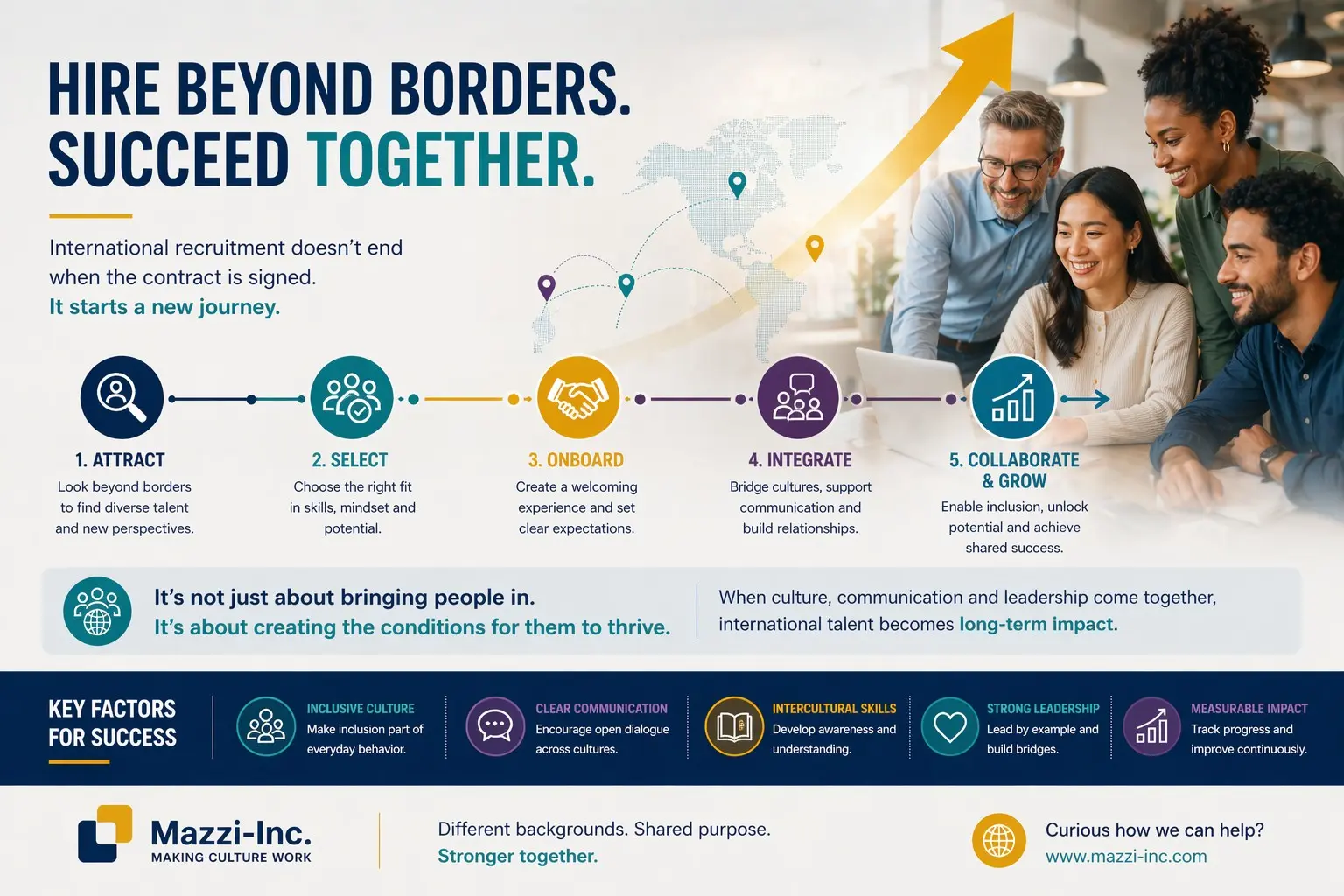
Why international recruitment often falls short of expectations
More and more organisations are hiring talent across borders. The reasons are clear: access to a broader talent pool, international expertise, and the added value of diversity. On paper, it makes perfect sense. And yet, in practice, international recruitment does not always deliver the expected results. Interestingly, the issue rarely lies in the hiring process itself. The real challenge often begins after the contract is signed. Because hiring international talent is not the end of the process—it is the starting point.
The blind spot in recruitment: the organization itself
Organisations tend to invest heavily in finding the right candidate. Skills, experience, and cultural fit are carefully assessed, and the recruitment process is often well-structured. But one critical factor is frequently overlooked: the organisation. Even the most qualified candidate enters an existing environment—one shaped by implicit norms, communication styles, and unspoken expectations. When that environment is not prepared for diversity, friction emerges. Not because the hiring decision was wrong, but because the context did not adapt.
Organisational culture as the deciding factor
International employees do not join a blank slate—they step into a culture that already exists. When that culture remains implicit, it can create confusion. Informal communication in a dominant language, unspoken expectations, and everyday habits that feel natural to insiders may be unclear to newcomers. These patterns may seem small, but they have a significant impact on how people experience collaboration and belonging. And that is where success is determined.
The myth of “they will adapt”
A common assumption is that new employees will naturally adjust. In international contexts, this rarely happens without effort. Learning a language takes time. Cultural norms are not self-evident. And integration does not happen automatically—it requires interaction and mutual adjustment. When expectations are one-sided—“they need to adapt”—distance and frustration often follow. Not because people are unwilling, but because the conditions for integration are missing.
Why onboarding is where success begins
If organisations want to make international recruitment successful, they need to look beyond hiring. The real work starts with onboarding. Not just in terms of processes, but in how culture and collaboration are introduced. How are expectations communicated? How is interaction shaped? And how does someone become part of the team? Without this focus, differences become barriers. With the right approach, they become a source of strength.
The hidden cost of poor integration
When international employees do not fully integrate, the consequences are both visible and costly. Engagement decreases, turnover increases, and the investment in recruitment delivers less than expected. In many cases, recruitment costs alone can reach 20–30% of annual salary—without even accounting for lost knowledge and potential . But perhaps the biggest loss is less tangible: the opportunity to truly benefit from diversity.
Leadership makes the difference
Ultimately, the success of international recruitment does not depend on HR alone—it depends on leadership. Leaders shape how teams interact, how communication flows, and how inclusive the work environment truly is. They make expectations explicit, encourage interaction, and create space for differences to be understood. And perhaps most importantly, they recognise that integration is not a one-way process. It is not only the new hire who adapts—the team does as well.
From hiring to sustainable collaboration
International recruitment is not a standalone process. It reflects how an organisation operates as a whole. When organisations actively shape their culture, invest in leadership, and strengthen collaboration, recruitment becomes more than a transaction—it becomes a foundation for long-term success. And that is where real value is created.
Reflection: how prepared is your organisation?
It is worth reflecting on what happens after hiring. How are international employees welcomed? To what extent is your culture aligned with diversity? And how actively is collaboration supported? The answers to these questions often determine whether recruitment becomes a success—or a missed opportunity.
Strengthening intercultural collaboration with Mazzi-Inc.
At Mazzi-Inc., we help organisations turn international recruitment into sustainable collaboration. We support teams and leaders in developing intercultural competencies, strengthening leadership, and building inclusive organisational cultures. Always practical, relevant, and directly applicable.
Ready to get more from your international talent?
International recruitment only creates value when people truly become part of the organisation. Curious how your organisation can make that shift? We’d be happy to explore this with you. Get in touch and discover how we help organisations turn hiring into long-term collaboration.