Why trust is a leadership challenge
International teams collaborate across borders, time zones, and cultures—often without ever meeting in person. Much of that collaboration takes place through short calls, emails, and digital tools, where efficiency and speed are key. And yet, we expect collaboration to run smoothly. In reality, it rarely does. Effective collaboration does not emerge automatically. It requires structure, intention, and, above all, trust. Without trust, communication remains surface-level, misunderstandings arise more easily, and ownership begins to fade. But trust is not a universal concept. What feels natural and obvious to one person may mean something entirely different to another. And that is exactly what makes trust a leadership challenge.
What do we actually mean by trust?
In many organisations, trust is often treated as something that simply develops over time. In practice, it is rarely that straightforward. Trust is better understood as a conscious choice—the decision to give space while remaining aware of potential risks. This is often referred to as authentic trust. For leaders, this creates an ongoing balance. They provide direction without becoming controlling, remain open without losing clarity, and invest in relationships without compromising accountability. However, how this balance is expressed varies significantly across cultures.
One concept, different expectations
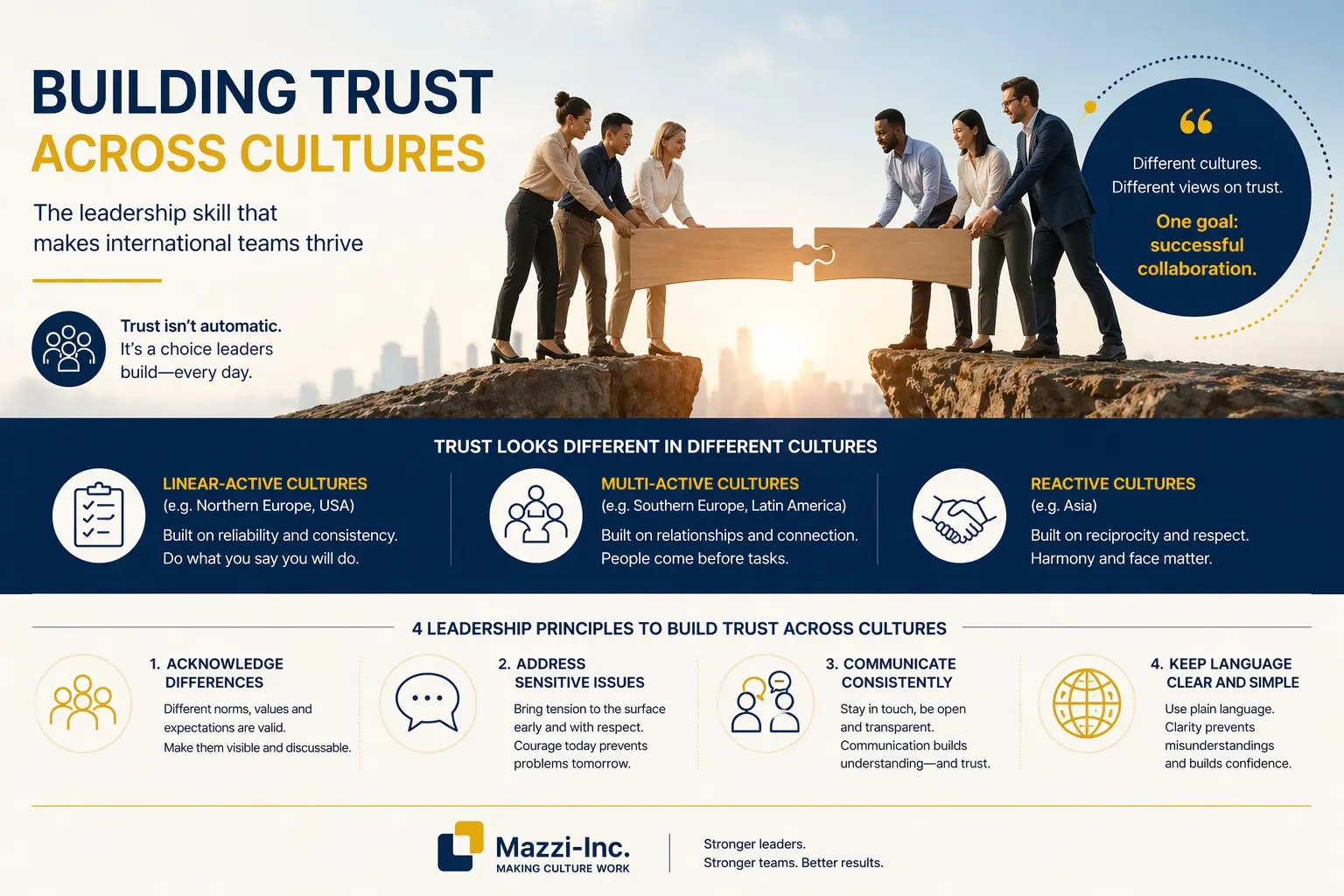
What is considered “trustworthy” is far from universal. In some cultural contexts, trust is built through consistency. Keeping commitments and acting predictably forms the foundation of reliable collaboration. In others, trust develops through relationships. People need to know each other personally before they fully engage professionally. There are also contexts in which trust is closely tied to respect, harmony, and reciprocity. As reflected in models such as that of Richard Lewis, these differences are not incidental—they are structural . For leaders, this leads to a simple but critical insight: you cannot rely on your own definition of trust.
Where things go wrong in international teams
When these differences remain implicit, misinterpretations arise quickly. Behavior is assessed through one’s own cultural lens. Someone may appear distant while actually aiming to be professional. Communication may feel indirect when it is intended to be respectful. Decision-making may seem slow, while in reality it is carefully aligned. What is often overlooked is that everyone is trying to be trustworthy—just in ways that align with their own cultural logic. And this is precisely where leadership becomes essential.
Actively shaping trust
Effective leaders do not wait for trust to emerge. They build it intentionally. This starts by making expectations explicit. What does effective collaboration look like in this team? How do we communicate? When and how do we address issues? Leaders also create space to discuss differences, not as problems, but as part of how the team functions. They encourage dialogue and help team members interpret each other’s behavior more accurately. Perhaps most importantly, they act as bridge-builders between perspectives. Intercultural leadership, in this sense, is about shaping trust deliberately rather than assuming it will develop on its own.
Leadership in practice: building trust across cultures
In everyday practice, this requires conscious action. It begins with acknowledging differences—not as obstacles, but as valuable input for collaboration. It also involves addressing tensions early, before they escalate or remain unspoken. The way communication is structured plays a crucial role as well. Regularity, clarity, and openness contribute to predictability, which in turn strengthens trust. At the same time, leaders need to adapt their communication style. What is clear in one context may create confusion in another. Effective leaders adjust their approach to fit the team they are working with.
Reflection: how do you shape trust?
Trust often feels intangible, yet its impact is very real. What definition of trust do you apply—perhaps without realizing it? To what extent does that align with your team? And how actively do you invest in building trust? These questions provide valuable insight into how trust actually functions within your team.
From trust as a feeling to trust as a leadership skill
In international teams, trust is not a given. It is a capability—and a choice. Leaders who navigate diversity effectively understand differences, make expectations explicit, and continuously invest in relationships. They do not treat trust as something that simply appears, but as something that needs to be actively developed. And that is where sustainable collaboration begins.
Strengthening intercultural leadership with Mazzi-Inc.
At Mazzi-Inc., we support leaders in building trust within international and intercultural teams. We help organisations develop intercultural leadership, strengthen communication, and improve collaboration. Always practical, relevant, and directly applicable.
Ready to strengthen trust in your team?
Want to lead more effectively in an intercultural environment? We’d be happy to explore this with you. Get in touch and discover how we help leaders build trust across cultures.
Discover more about our Intercultural Leadership Training Programmes