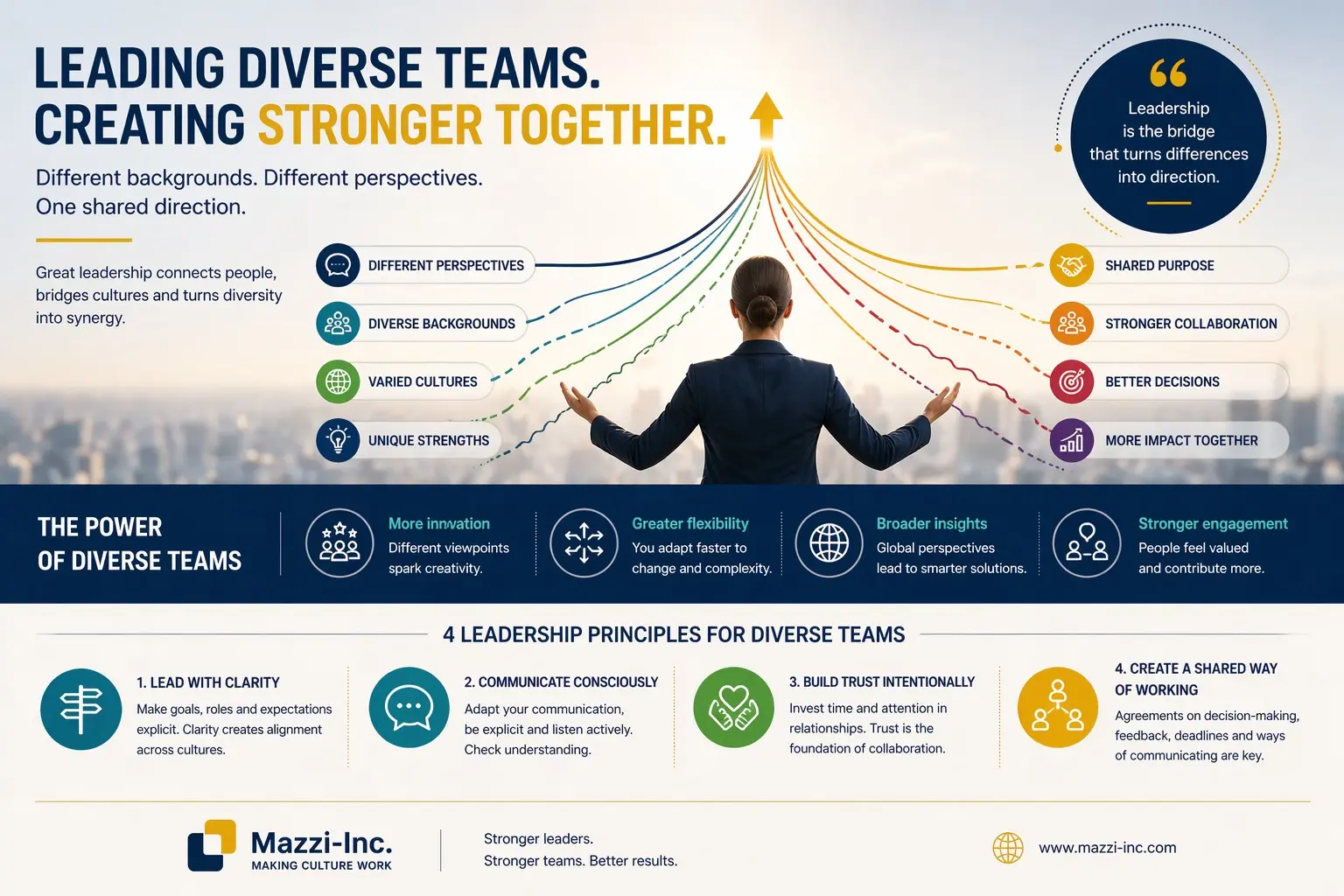
Why leading diverse teams requires a different approach
Teams are becoming increasingly international. People collaborate across countries, cultures, and perspectives, bringing with them a wide range of experiences and ways of thinking. This diversity is a clear asset—one that enables organisations to become more innovative, adaptable, and resilient. At the same time, it fundamentally changes how collaboration works.
As diversity increases, so do differences. Not only in communication, but also in expectations, decision-making, and ways of working. What feels obvious to one person may be unclear—or even uncomfortable—to another. And that is where leadership becomes essential. Because navigating these differences does not happen automatically. It requires conscious, intercultural leadership .
The strength of diverse teams
While the complexity of diverse teams is often emphasized, their true value lies in the diversity itself. Teams that bring together different perspectives are better equipped to generate new ideas, challenge assumptions, and respond to change. International collaboration can lead to more innovative solutions and more effective ways of working. But this potential does not unfold on its own. Without the right leadership, differences tend to coexist rather than reinforce one another.
What goes wrong without intercultural leadership
In practice, unmanaged differences often lead to friction. Misunderstandings arise from different communication styles. Expectations remain implicit and are interpreted differently. Decision-making slows down, and frustration builds around pace, roles, or responsibilities. What is often missing in these situations is a shared frame of reference—a common understanding of how collaboration works within the team. And that does not emerge by itself. It needs to be actively shaped.
Balancing clarity and flexibility
At its core, intercultural leadership is about balance. On one side, teams need clarity. Clear direction, structure, and explicit expectations provide stability in a diverse environment. On the other side, diversity requires flexibility. It calls for openness to different perspectives, the ability to adapt behavior, and the willingness to move between approaches. Effective leaders operate between these two dimensions. They provide structure without becoming rigid, and they allow flexibility without losing direction. As highlighted in the original text, this balance between guiding and trusting is essential .
Clear communication as the foundation
In diverse teams, implicit communication is one of the biggest risks. What seems self-evident to one person may not be for another. That is why, in international teams, communication needs to become more explicit. This does not mean overcomplicating things—it means being intentional. Goals are clearly articulated, roles are defined, and expectations are made visible rather than assumed. When communication becomes more explicit, there is less room for misinterpretation. And that creates a stronger foundation for collaboration.
Managing differences instead of avoiding them
A common misconception is that differences need to be resolved or eliminated. In reality, the value lies in learning how to work with them. Effective leaders do not remove differences—they manage them. They develop insight into communication styles, perceptions of hierarchy, attitudes toward time, and approaches to feedback. They make these differences discussable, without turning them into problems. And they actively guide the team toward shared agreements and a common way of working. That is where complexity turns into strength.
Leadership in practice
In practice, intercultural leadership means continuously adjusting to what the team needs. This may involve adapting your leadership style depending on the situation or individual. It may mean being more explicit than you are used to, simply because clarity is required. Or it may involve actively investing in trust, knowing that trust does not automatically emerge in diverse teams. Creating a shared way of working is equally important. Teams perform best when there is clarity about how they collaborate—without losing the richness of individual differences.
Reflection: how do you lead diversity?
It is valuable to reflect on your own role as a leader. To what extent do you adapt your leadership style? How explicit is your communication? And how actively do you shape collaboration within your team? These questions often reveal how effectively diversity is being managed in practice.
From diversity to synergy
Diversity alone does not guarantee success. Leadership determines whether differences remain separate or become a source of strength. When leaders understand differences, structure communication, and actively build trust, something shifts. Diversity turns into synergy. And that is where real impact begins.
Strengthening intercultural leadership with Mazzi-Inc.
At Mazzi-Inc., we support leaders in navigating and leveraging diversity in (international) teams. We help organisations develop intercultural leadership, strengthen communication, and improve collaboration. Always practical, relevant, and directly applicable.
Ready to strengthen your leadership in diverse teams?
Want to unlock the full potential of your team’s diversity? We’d be happy to explore this with you. Get in touch and discover how we help leaders turn differences into strengths.
Care to learn more about our Intercultural Leadership Training Programmes?