Why working with Belgian colleagues offers more than you might expect
The Netherlands and Belgium share a border, a language, and strong economic ties. At first glance, collaboration seems straightforward—almost self-evident. And yet, many professionals notice subtle differences in how work gets done. Not major contrasts, but small nuances that shape communication, decision-making, and collaboration. That is exactly where the opportunity lies. Because where differences become visible, there is space to complement each other, learn from one another, and strengthen collaboration. Intercultural collaboration does not begin with distance—it begins with awareness, even when cultures appear close.
Close, but not the same
Because the Netherlands and Belgium share so much, it is easy to assume that collaboration will naturally run smoothly. As a result, differences are often underestimated or overlooked. But it is precisely these subtle differences that make collaboration more interesting—and more effective. Not as obstacles, but as opportunities to refine how people work together.
Two styles, one powerful combination
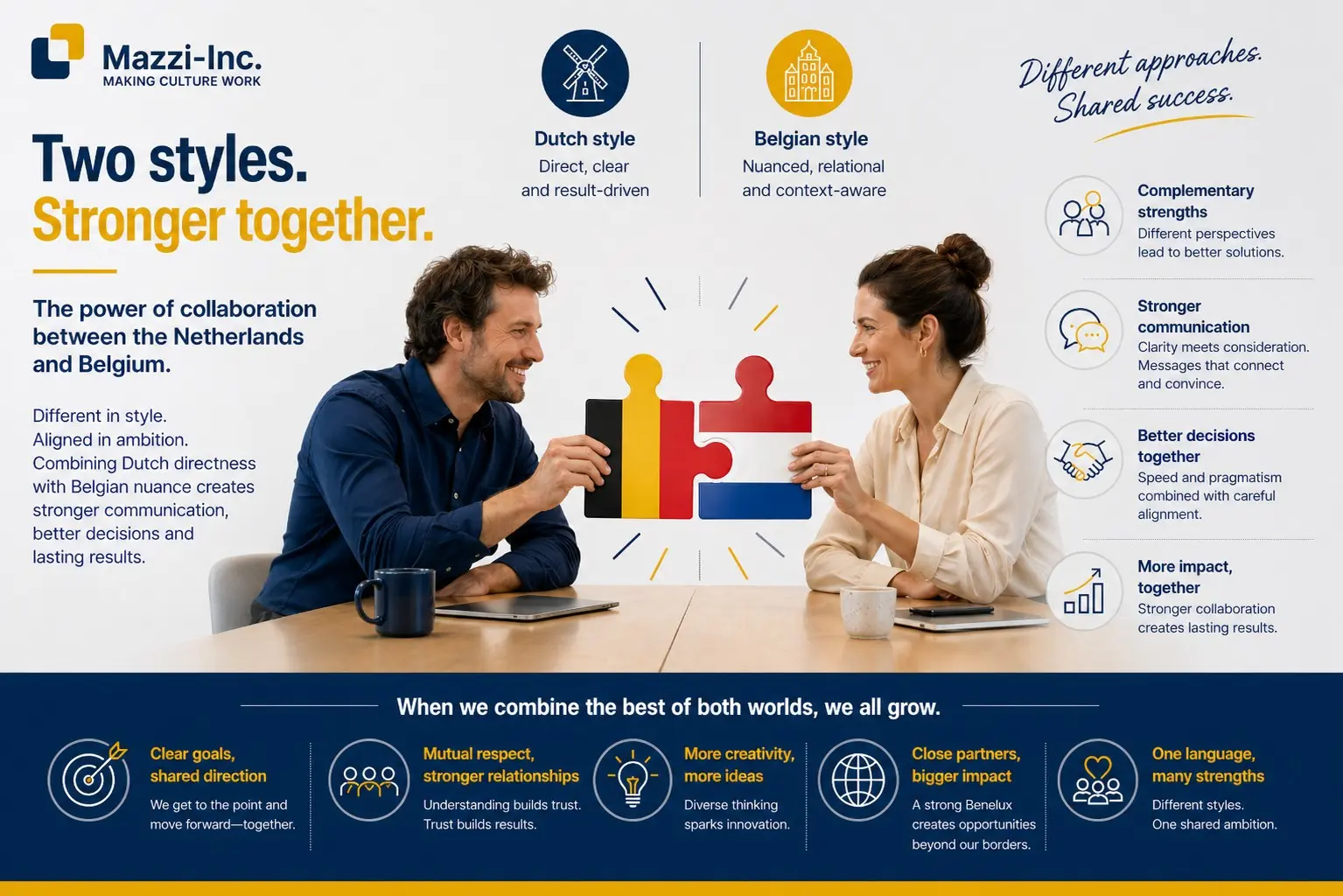
One of the most noticeable differences lies in communication. Dutch communication is often characterized by directness. Conversations move quickly to the point, messages are explicit, and clarity is prioritized. Belgian communication, on the other hand, tends to emphasize nuance. There is more attention to context, relationships, and how a message is delivered. When these styles come together, an interesting dynamic emerges. Directness creates clarity and speed. Nuance adds care, alignment, and sensitivity. Together, they result in communication that is both efficient and thoughtful.
How differences add value in practice
This dynamic becomes visible in everyday collaboration. In decision-making, a Dutch approach often brings speed and pragmatism, while a Belgian approach contributes careful alignment and broader support. The result is decisions that are both efficient and well-grounded. In feedback, Dutch directness ensures clarity, while Belgian diplomacy helps maintain relationships. This creates feedback that is both clear and constructive. In business communication, the Dutch focus on results is complemented by the Belgian attention to tone and context, leading to messages that both convince and connect.
Cultural awareness as the key
The strength of this collaboration does not lie in choosing one style over the other, but in combining them effectively. This requires awareness—of your own preferences, of how others approach communication, and of when to adapt your behavior. When teams develop this awareness, collaboration shifts. Friction decreases, mutual respect grows, and communication becomes more effective.
What this means for leadership
For leaders, this dynamic creates a clear opportunity. Intercultural leadership in this context is not about standardizing behavior, but about connecting different approaches. It means creating space for both directness and nuance, making expectations explicit, and actively bridging perspectives. Leaders who do this well help teams move beyond differences and use them as a source of strength.
Small adjustments, meaningful impact
Improving collaboration does not require major interventions. Often, small, intentional adjustments already make a noticeable difference. Adapting your communication style can significantly improve how messages are received. Paying attention not only to what you say, but also to how it is interpreted, helps prevent misunderstandings. Investing in both relationships and results is equally important. In Dutch-Belgian collaboration, the two are closely connected. And perhaps most importantly: make differences discussable—not as problems to solve, but as perspectives to understand.
Reflection: how do you collaborate across styles?
It is worth reflecting on your own approach. How direct is your communication style? How do you respond to more nuanced or indirect communication? And to what extent do you adapt your behavior when working with others? These questions help uncover patterns that often remain implicit.
From nuance to strength
Collaboration between the Netherlands and Belgium is not something that needs to be fixed—it is something that can be strengthened. When differences are used consciously, communication becomes more effective, collaboration becomes more aligned, and results improve. Because when cultures are close, the real impact lies in the nuance.
Strengthening intercultural collaboration with Mazzi-Inc.
At Mazzi-Inc., we help organisations recognise and leverage these nuances in practice. We support teams and leaders in strengthening intercultural communication, leadership, and collaboration. Always practical, relevant, and directly applicable.
Ready to strengthen your collaboration?
Want to get more out of working with Belgian colleagues? We’d be happy to explore this with you. Get in touch and discover how we help teams turn differences into strengths.
Discover more about our Country & Region Culture Training Programmes